

Are you wondering about how to make your home school environment into one that has fewer manmade electromagnetic frequencies in it?
Here are my favourite tips plus a bit of my personal story.
Table of Contents
Video Clip
This video clip was taken from a workshop I presented to homeschool parents on the topic of learning environments.

Free Printable Notes
(These notes are also written below in the sections of “12 General Tips…” and “10 More Ideas”. The bottom sections are not included in the printable.)
Click on the button for the printable notes that go along with this video clip.
12 General Tips to Reduce EMF Exposures
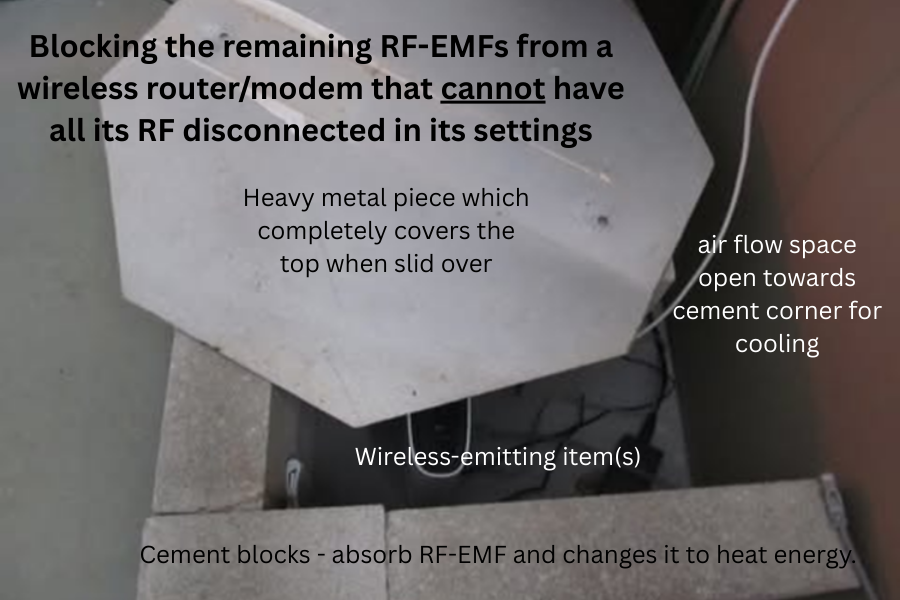
- Turn OFF your wireless ROUTER and DEVICES while sleeping so your body has chance to repair and sleep more soundly. It is strongly proven that RF decreases melatonin and as a result, your sleep quality. Simply sleeping with less RF can make a big difference! Double-check that those sneaky/hidden “second antennas” are also disabled on wired things like printers.
- Alternatively, a router/modem and other RF-EMF-emitting devices that are not turned “off” can be covered with a “Faraday cage” that allows air-flow (to prevent over-heating) or other materials which reduce or prevent these signals from entering the living space. Above is an example of a router/modem being surrounded by cement blocks in a basement corner.
- Keep your device on “AIRPLANE MODE” or “off” unless you need to use it. (Also, remember to disable any BLUETOOTH if it is a separate setting on your device. “Airplane mode” doesn’t always look after that anymore so you would take the time to make sure both are disabled if you want to reduce your RF.)
- If you need to use a CELL PHONE, if possible, using it as a speaker phone to talk is better than holding it to your ear. Try not to store it close to your body. If you don’t “need a cell phone”, aim for other ways to communicate and find information instead. Note: Changing your settings, turning it off or on, receiving or sending data, or using a cell phone to see websites causes extra spikes of radiation. (I try to be about 30 feet away from someone changing their settings.)
- In today’s world, landline phone systems are becoming more digital, requiring the phone service to go through a router/modem. And the router/modem settings might not allow a user to disable all of the RF signals (even if sometimes they say they do. We can measure the RF levels and have experienced this situation.) If a person does not need access to a computer (e.g. an elderly person who doesn’t email people), a cell phone might be the better solution for phone communication instead of a landline with a router/modem system. The cell phone of course, should be stored as far away from the person as sensible. And a phone’s signals when it is not being used but still “on” can be partially-blocked with metal or cement so that it can still receive calls (perhaps through a window) but that there is a barrier between the phone and where the person usually is. Cell phones that are “on” tend to continue radiating signals even when “not being used”.
- Another way to reduce cell phone signals is to use it by hardwiring it to ethernet and disabling the wireless on the setting. This is mentioned on our post here: “How Can I Use a Mobile (Cell) Phone Better?”
- Use WIRED connections where possible for your computer system and home phone. (Disable the wireless; don’t just plug in wires; you have to also change the settings if you’re wanting to avoid RF.) Avoid using a cordless phone – put a long cord on a fully-wired kind of phone if you need to walk around while talking on one.
- Avoid using a MICROWAVE. Baby food can be warmed up easily in a bottle warmer or in a pot of water/double-boiler system. Hot water for tea is easy to heat on a stovetop in a pot.
- If possible, avoid all SMART METERS and SMART APPLIANCES in your home.
- If not possible, at least try not to sleep near one or in the path of a smart meter communicating with the antenna on the pole. Try asking the power company to move the smart meter to a post further down your driveway, away from the house. (Also consider methods to apply a “shielding” so that you use the science of a “Faraday cage” or similar to your advantage.)
- If you have a choice, avoid living in GEOGRAPHICAL AREAS that are close to cell towers, especially strong-emitting ones, and high voltage power lines or transforming stations or wind turbines or similar.
- Be careful if choosing off-grid applications – there are solar systems which do not have RF-emissions and the inverter should also be away from the house due to magnetic fields.
- Avoid TWO PRONG PLUGGED-IN items near your bed (where you sleep). If you unplug them, the electrical and magnetic fields will lessen significantly.
- Examples: digital clocks, lamps. Use 3-prong/grounded items instead or battery-operated items. Also, consider home heating that is not electrical baseboards near sleeping areas.
- If you have a METAL ROOF, make sure it is grounded properly. (An electrician can do this task.) Transformers may be able to be moved further from the house/sleeping areas too.
- Hire an electrician to check that your ELECTRICAL SYSTEM in your home is all proper and grounded – a safe panel, safe 3-pronged plugs throughout, no frayed wiring, etc.. Just because “it works OK to use something electrical” doesn’t necessarily mean it is OK for EMF levels.
- Spend more time OUTDOORS, in natural sunlight, on actual dirt/grass/ground (e.g. gardening, touching animals or fence posts which are grounded/connected to the ground, wading on sand), away from electricity and manmade radiation.
- Avoid using technological devices/screen-time a lot just before trying to sleep.
- Even brief outdoor moments on real ground before retiring for the night or during the day when feeling foggy/muscle tenseness can help.
- Keep stress minimalized. It doesn’t mean that you can control your life to not get any major “hiccups” in it but rather that “when you get lemons, you can make lemonade” because of your overall perspective/worldview. If stress isn’t managed well, it can actually expand/worsen the situation by highlighting troubles and/or by dealing with it on a wobbly/sinking foundation.
10 More Ideas for Limiting “Tech-Device Usage” at Home
- Consider using a group-based cell phone rather than an individual phone per kid. This means that your mature teens share a “family phone” that has minimal apps and is only used if needed to contact you (or for emergency numbers or important connections). Encourage them to keep it actually “off” unless it is in use. (Post-secondary students and employees might get their own phone which is totally understandable. But even then, they can be encouraged to minimize the number of apps on it and to use a wired device whenever they could do that instead of a wireless one.)
- If overwhelming/addictive apps that were purchased by a kid are an issue, consider “buying the apps back” so that they get deleted from a device without financial loss to your kid. (This tip was on Todd Wilson’s “Taming the Techno Beast” seminar at a homeschool conference and I thought it was an excellent tip to include.)
- Keep all technology out of the bedroom area. This means no TVs, no computers, no phones (unless a wired landline perhaps), no video games, no laptops, etc. in the bedroom. A computer/TV/laptop in the main living area where everyone in the family can be around helps to curb addiction and it supports accountability for temptations of overuse. (Also, keeping electronics out of the bedroom area encourages better sleep. Years ago when I was a young adult, that scientific fact was known in the medical world. The only exception to technology needing to be in a bedroom is if the person requires a medical device.)
- Put a password on your computer (or device) to prevent younger kids from being able to access it on their own. Instead, you (or a responsible teen) logs them in if they have a class online or are researching for a project. Change the password if the computer/device is getting used too much or the younger kids are learning the password from the older kids. (Yes, that means you are an active parent, actively involved in your child’s activities on a computer. There is nothing wrong with that and although it can be “inconvenient” for the short-term, in the long-term, it can help teach good management and communication skills.)
- Make your point with some humor… Years ago when all of our children were younger, we charged a fee for sitting to swirl on our computer chair. If they sat, they were to pay a “sailboat” coin (which is 10 cents in Canada). This deterred the habit of just plopping down in front of a computer. The idea is that if they want to ride on the “Swirlin’ Sailboat”, then they get to pay. For children who were supposed to be there for a computer lesson, I remember giving them the dime so they’d also be “paying”. We’d put a sign on the back of the chair with a large picture of the coin. (I think it was the main way a few of our kids learned coin identification for the dime!) This is memorable and fun if used periodically for short periods of time as a gentle reminder.
- Be a good example. How much are you on your favourite device (wired or wireless) scrolling through social media or listening to podcasts, etc.? You cannot expect a child or teen to reduce or stop their usage of tech if you aren’t willing to do the same with yours.
- Try not to train them to think that every free moment is a good opportunity to “check something”. Try to think of other quick things you can do in the “free moments” instead. (It might help to make a list?)
- Aim for real relationships more than virtual ones. Rather than having your kids play something online with cousins or friends, say that people in your family will only play with others when they (or you) are in-person with them. (Of course, that is assuming that “what” is being played is good.) And when your family visits with them, don’t just play with electronics or virtual things. Do and talk about stuff that is “real life” too.
- And yes, it should be expected that devices are “off” at meal-times. That’s just logical manners and courtesy to focus your current conversation with people you are actually seeing and who do care about you personally. I remember that my grandparents’ homes were where I “learned” what was on TV (since we didn’t have one of those in our home until I was a young adult). But I didn’t just watch TV when I visited my grandparents; it was only a portion of what I did when I was there with them. I’m thankful I was able to build a relationship with each of them rather than just having memories of staring at the screen.
- If you wonder “if” something might be “good” to have as entertainment in a Christian home, you’re welcome to click here for a downloadable/printable list of Bible references to think about. (This study came from a Sunday School lesson years ago.) A more general list is available on our website at this link.
- Parents, you don’t need to give a long explanation for every decision you make for the benefit of your family. You’re a parent, not a negotiator with a boss. In a normal/good relationship your kids should understand and trust that you love them and want what is best for them. You’re older and see a bigger picture that they might not yet be able to grasp until they are more mature. (Be honest with them though, if you do give any explanation of why you might be limiting or eliminating things they are used to.)
- If your teen/child or you really want to change to better self-control/management of technology but is struggling with addiction to it, regularly encourage and remind yourself and them of:
- The newness that we can have in Christ – study the Bible verses about the newness and cleansing that Jesus brings to a person’s life when they come to Him. Example: 2 Corinthians 5:17, 1 John 1:9
- The power that we can have in Christ to live a godly life – study the Bible verses about God’s strength, His power, the working of the Holy Spirit in a person’s life that is depending on Him. Example: Consider listening to sermons on our ministry website, “The Word In Our Hearts”. Many of them really helped me (Joy) grow as a Christian when I was in my teen years! Examples: C. U. Wagner’s series on The Holy Spirit, Ian Leitch’s series on The New Covenant (2 Corinthians), Bob Dowie’s series on “The Lord is”, etc..
Dear Christian Parent/Teacher: Your children/teens are counting on YOU to help them navigate safely and victoriously through this field in our culture. Point them to God, pray for them, pray for yourself, be in the Word of God (Psalm 119:9, 18, 37; 101:3; 112:1-2, 7; 138:2b).

Disclaimer: The information presented in my comments reflects my personal understanding and experiences. This workshop has not been evaluated by medical or legal professionals. I am not a medical doctor. This is a simple reminder that you remain entirely responsible for your own opinions, conclusions, and actions and that you should always aim to research matters further if it is important to you.
You may also want to read:
Homeschoolers, Schools, and Wireless Technology (updated): This page has an additional list of links for help to decrease or eliminate your dependence on technology, especially of the portable/always available kind. Use technology as a tool not as a companion.
How Can I Use a Mobile (Cell) Phone Better? This page has ideas for wiring tablets and phones alongside other tips for decreasing one’s dependency on wireless technologies.
“But my family doesn’t understand ‘why’ we should reduce the fun or convenient wireless tech we’ve been using!”
I recognize that parents and teachers should make decisions on this. But it is ALSO something that I think many children and teens should be given real reasons for. I think most of them CAN understand if they are taught “why”.
Word pictures sometimes help children and teens (and adults) to understand that popular wireless technologies are a type of invisible pollution affecting living things (including humans) and why it can be a good choice to reduce having much of it around us. Here are three that I’ve used:
Tobacco Smoking
In more recent decades, more people have understood the health effects of smoking cigarettes AND being around “second-hand smoke”. It is common-knowledge that many public places have a section (usually outdoors) for those who choose to still smoke. But the rest of the people can eat, shop, play sports, etc. in a non-smoking environment.
Years ago, a portion of the human population were extra-sensitive to smoke. They displayed adverse symptoms (e.g. coughing, shortness of breath, etc.) if they were in areas where people were smoking. However, because many people could initially tolerate this kind of smoke, it was initially thought of as acceptable to both continue and promote smoking. Some of those people who could initially tolerate it without symptoms, eventually suffered in health as a direct result of their frequent exposures.
Smog from Factories, Traffic, Pest/Weed Chemicals, etc.
Learn about birds and other animals that are “indicators” of the effects of chemical pollution. They cannot always tolerate certain chemicals well and their decline indicates to people that something manmade is in the area that isn’t good to continue at those levels.
Conservation efforts to help the peregrine falcon population which suffer from exposures to the DDT pesticide is a nicer story to look at because reducing that chemical has helped these birds not be as endangered now.
Both smoke and smog are sometimes used to explain the problems associated with “e-pollution”, (electronic pollution). Wireless signals are an addition to our natural environment, even though we can’t see them there. And some plants, animals, and humans are becoming affected.
Alcohol (Drinking)
Just like one glass of wine can affect different people in different ways (e.g. giddiness, violence, no immediate effect), so too using a cell phone can affect different people in different ways (e.g. headache, skin burns, digestive issues, fatigue, cancer, etc.).
A person might not drink any alcohol. Some people drink only a small amount (“social drinking”) but not enough to become drunk. Other people drink enough to become drunk. And still others become alcoholics. Some people feel the immediate effects but some will continue on until the consequences of unwise choices become more apparent.
“So, for wireless tech usage, how much is “too much”?”
Like alcohol, it will depend on the person for how much can cause immediate symptoms. But eventually, the non-drinker or social drinker generally has fewer related health concerns than the heavier drinker.
So what might be considered a “heavy-user” of wireless tech?
Here is a very interesting quote in an article by professor and researcher, Magda Havas, about cancer concerns with cell phone usage. It is from September 2010, in a time period when cell phone usage wasn’t as prominent, nor were towers or public wifi and so radiation had lower levels compared to today’s technologies…
“The OAHPP (Ontario Agency for Health Protection and Promotion) presented studies showing that long-term, frequent users of cell phones may develop tumors on the same side of the head where the cell phone is used and those living near cell phone base stations may experience adverse health effects. The statement about cell phones is echoed by the World Health Organization and is based on the INTERPHONE 3 study.
“The largest ever international study of mobile phone safety has concluded that the devices do not raise the risk of brain cancer, except for a possible slight increase in tumours among the most intensive users.”
The term “most intensive users” is defined as total cumulative use at or exceeding 1640 hours.” (Source link)
How many hours (including exposures to Wi-Fi and Bluetooth even when “not being used”) do you get?
Try calculating an estimate for the number of hours per school year for your situation.