
To see the introduction of this post series, please go to Part 1.
PART 5 is about Jesus’ death and burial.
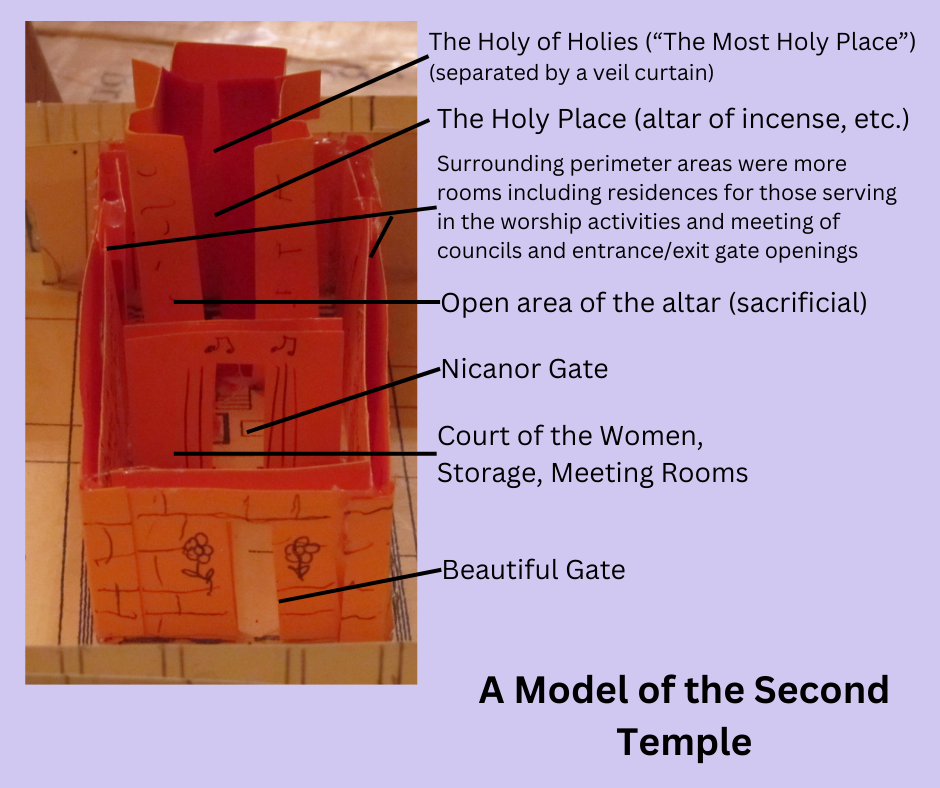
Background Information: The Temple
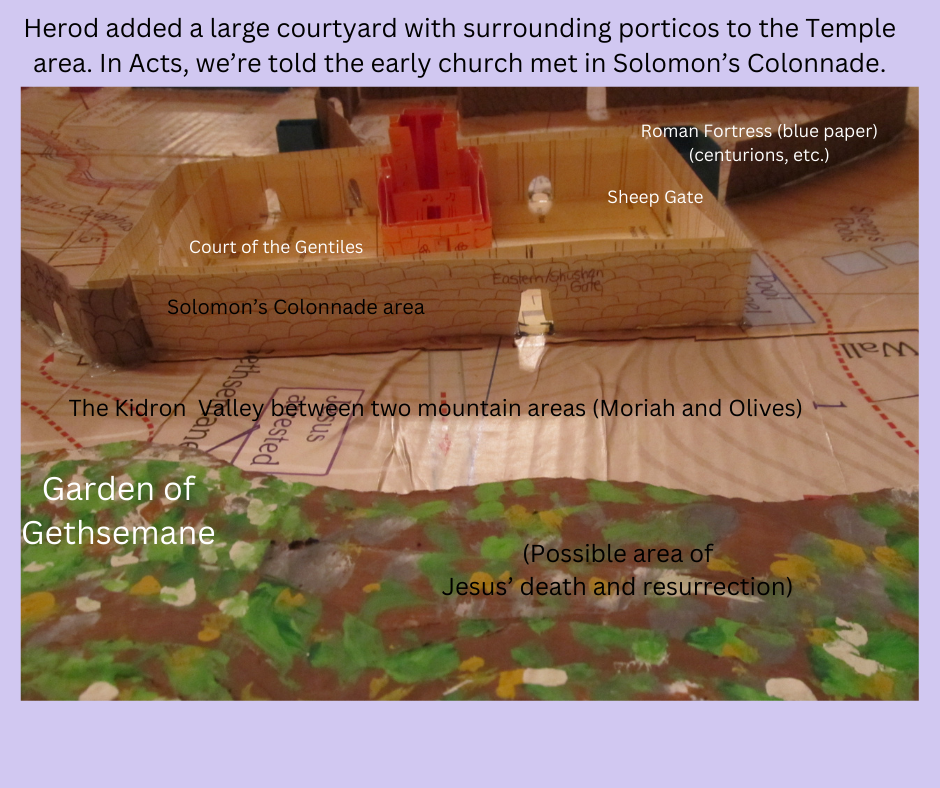
The Temple was the building within the patio/courtyard area that was also surrounded by porticos.
It was built by Nehemiah’s workers but later renovated with the added patio area by Herod the Great.
It is known as “Herod’s Temple” or the “Second Temple” because it came after Solomon’s, which was the first one.
This is the building that Jesus said would be completely destroyed with not one stone left in place upon another and it was a few decades later (in 70 A.D. when Jerusalem was destroyed by the Roman army and those which helped them).
Most sacrifices would take place in the Temple area. Blood from sacrifices for a covering of sins of the people was offered by the high priest when he went into the innermost portion called the “Holy of Holies”. He did that once a year, on the Day of Atonement (which is a different time of year and not Passover). (See this Bible Hub link and/or this Got Questions link for more background information)
(In our teaching model, we added a torn piece of cloth, to represent what happened to the veil when Jesus died. (Matt. 27:51).
Crucifixion – Where?
The Bible gives us a few descriptions – Golgotha, Calvary, “numbered with the transgressors” (died as a criminal, Mark 15:28) and “outside the gate” which is a term used for the cleansing sacrifice the Israelites had regarding a red heifer (Hebrews 9:11-15, 22-28, 13:11-12, Numbers 19:1-9, cf. John 2:6)
There was also “nearby”, a new tomb of a rich man (Isaiah 53:8-9, Matt. 27:50, John 19:41).
We have come to the understanding that the traditional places thought to be where the crucifixion and burial of the Lord took place, are only that – tradition. In other words, those places do not have much support from the Bible or from history, if any.
When one looks at “where” the traditional sites are for the crucifixion, Gordon’s Calvary or over by the Church of the Holy Sepulchre, neither of these options fit with account of the centurion who was at the foot of the cross who could see the veil of the Temple torn from top to bottom.
You can see places in Jerusalem on the Day of Discovery videos at these links: Behind the Easter Story: Part 1 and Behind the Easter Story Part 2.
On the model below –
#1. is the area of the Church of the Holy Sepulchre, which is completely behind the Temple walls, across the city.
#2. is the area of Gordon’s Calvary, which is also out of sight of being able to see the veil of the Temple torn from that hill.
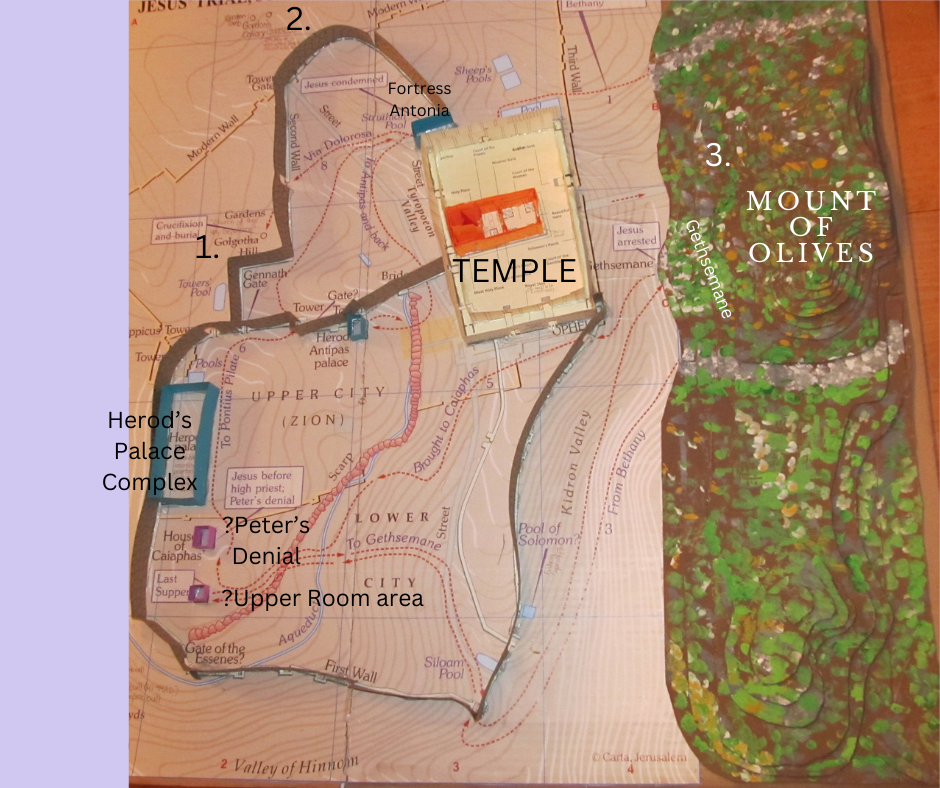
There are a few good reasons why some people believe that the more-likely place of Jesus’ death was on the Mount of Olives.
I’ll summarize them below. There are authors who mention some of these things but there is also a documentary video on Youtube by Jimmy Deyoung in Kingdom Come (a “look at the book” of Matthew) which includes this topic, from around 1 hour 40 minutes onto about 16 minutes later. I’ve cued it up a bit before that point below, to include about Gethsemane.
Reasons Pointing to the Mount of Olives Location for the Crucifixion
- The “outside the gate” term fits better with the Mount of Olives location. It would still be “connected” to Mount Moriah due to the red heifer sacrifices.
- It was also near a road from where passerbys hurled insults to the cross (Mark 15:29).
- Golgotha is a Hebrew word that appears a number of times in the Old Testament. It refers to “a place of counting heads”, not necessarily a “skull face rock”.
- Romans tended to punish criminals at a location close to where the criminal did the crime or was arrested for it. Jesus was claiming to be King as He entered Jerusalem on a donkey’s colt and was arrested in Gethsemane, both occurring in the area of the Mount of Olives.
- The first traditional site (Church of the Holy Sepulcher) was chosen due to mysticism and healing of a sick woman when a cross shape was placed on her. The second site (Gordon’s Calvary) looks the way it does due to erosion and it changes what it actually looks like over time/weathering.
- Neither from the traditional site, nor Gordon’s Calvary/Garden Tomb site, would the veil have been able to be seen torn from top to bottom. But the centurion saw this from where he was at the cross when Jesus died.
Christ’s Suffering on the Cross
Years ago, I worked at a family camp, caring for young children during many of the chapel services. One evening service stands out in my memory of being so impactful over in the chapel. (Children were fine even though parents came to pick them up later than usual.) The sermon was called, “The Cross of Christ” (Dr. Paul Dixon, Cedarville U.) and I later shared parts of it in my high school in a lunchroom around Easter time. You can hear the audio of it on our other website at this link. Dr. Dixon read from Isaiah 52 and 53 for some of his message.
Burial/Entombment
Jesus was buried before sundown, toward the end of Passover, around when the Feast of Unleavened Bread was beginning. They used a tomb nearby. (John 19:41)
Acts 2:27 – Jesus’ body, like unleavened bread, saw “no corruption” (cf. Deut. 16:4a, 1 Cor. 5:7-8, Matt. 16:11-12, 26:26, Luke 22:18, John 6:32-35ff).
Buried with Haste
The popular idea that Nicodemus and Joseph were hurrying so they didn’t “work” on a Sabbath is a less likely the primary reason for why they were “hurrying”. Their “work” was like that of Numbers 9:1-14, meaning their Passover celebration could be delayed a month.
So why did they need to be “in haste”?
- Joseph of Arimathea –
- The Bible tells us that Joseph was timid (needed courage, had been secretly a believer) and had not consented to Jesus’ death, even though he was a member of the Sanhedrin, and that means he would have had very little if any sleep the night before with the trial going on.
- He had to travel from the area of the cross to Pilate (quite possibly across the city in Herod’s palace where Pilate often would have stayed. Mark 15:44-45 tells us that Pilate was surprised that Jesus was already dead and took the time to confirm this with the centurion – a possible more couple of trips across a city.
- By the time Joseph was allowed to do so and together with Nicodemus had gathered basic supplies with all the walking with emotions and fatigue plus the task of removing the body, they would need to naturally hurry to get to the place(s) they were staying before supper-time.
2. But perhaps a big reason for them to hurry was also that it was religious leaders didn’t want dead or dying bodies to be on crosses that evening and already were planning to get these removed (John 19:31) so Joseph and Nicodemus would want to arrive before those leaders did!
3. I think another reason was that God knew the time when Jesus was going to resurrect and that to fulfil prophecy, He needed to be in the tomb “belly of the earth” for 3 days/3 nights.
- (Remember – in the Jewish reckoning of timing for days/nights (a general principle they’d agree on), if it was any portion of a day, it was considered “one day”; and any portion of a night, it was considered “one night”. This is both an explanation sometimes given by those who think Jesus died on a Thursday or a Friday, the difference essentially being did Jesus resurrect at sunrise (after being in the tomb for a small bit of the “3rd day”) or in the “night hours”, before morning. Otherwise, a timeframe of a Friday crucifixion to a night hours resurrection on Sunday is 2 ½ days/nights rather than 3.)
More than One Sabbath that Week
A regular Sabbath rest-day occurred each 7th day (Lev. 23:3). (A Sabbath is Saturday.)
But sometimes, there could be a “special Sabbath” which was on a different weekday than the regular Sabbath.
The idea of more than one Sabbath in a week is found in John 19:31 (which indicates that the Sabbath that was coming up next day was a “high Sabbath”, sometimes known as a “holy convocation” such as in Leviticus 23:7-8.
This also means that there could be more than just one “Day of Preparation”.
This is explained further at this link.
Song Suggestions
(Some of these song titles are hyperlinked. For others, you should be able to find them easily, if desired.)
- Watch the Lamb – story told in song of Simon of Cyrene, who helped to carry Jesus’ cross
- God Himself the Lamb
- Behold the Lamb (slain from the foundation of the world)
- Lamb of Glory
- Our God Reigns (chorus with verses)
- God So Loved the World
- Merciful Savior (Janet Paschal)
- Why? (John M. Moore, may be also in a hymnal)
- Written in Red
- It is Finished (Gaither)
- Beneath the Cross of Jesus (hymn)
- When I Survey the Wondrous Cross (hymn)
- Cross for a Crown (Steve Amerson)
- He Didn’t Come Down (The Kingsmen)
- Ten Thousand Angels/He Looked Beyond My Fault and Saw My Need
- Only Jesus/Calvary’s Love
- Our Great Savior (Hallelujah! What a Savior)
- How Great Thou Art
- The Unveiled Christ (hymn)
- I’m Free (Gaither)
- Hallelujah! Praise the Lamb
- Jesus Loves Me (children’s hymn)
- And Can It Be? (hymn)
- Jesus Paid It All (hymn)
- Thank You, Thank You My Lord
- It’s Still the Cross
- I Am Redeemed (Steve Amerson)
- Jesus Loves Me Like No Other (John G. Elliott)
- Christ is the Saviour of Sinners (tune: “Showers of Blessing”)
- Isn’t the Love of Jesus Something Wonderful (hymn)
- The Wonder of It All/O Sacred Head, Now Wounded/O the Deep, Deep Love of Jesus (This is my piano arrangement. Timothy Starr was an interim pastor at our church when I was a young person. He asked me if I would try to make an arrangement of “O Sacred Head, Now Wounded” for the evening service as it was one of his favourites and he wanted it to go along with his sermon. This medley came from that Sunday afternoon and was later recorded in 1994.)
- The Love of God (This is considered “my” arrangement but I had heard something like it on a fuzzy radio station and worked on playing this medley by ear and writing down some of the notes. But the radio station couldn’t figure out who had originally played like it. It is one of my (many) favourite hymns and became the “title song” for the cassette I later professionally recorded.)
References
See also to Part 1 (Reference section)