
To see the introduction of this post series, please go to Part 1.
This page is Part 4 and is about the Last Supper, Passover, Feast of Unleavened Bread, in the Garden of Gethsemane, and trials of Jesus.
(If following the timeline I’ve been referring to for the “Passion Week” which has the crucifixion in the daytime on Thursday, the Passover began Wednesday at sundown. Part 1 of my comments about the Passover are in the previous post.)
About Passover (Part 2)-
The main Passover passages in the Old Testament are Exodus 12 (the original one where the children of Israel ate in haste) and Leviticus 23:1-16 (a key chapter on the various feasts of the LORD).
The first Passover had some different things in it compared to some other years of celebration so we can expect the Passover with Jesus might have some different aspects too – He is Lord over the “special days” too (Matt. 12:8)!
The Last Supper
Jesus “kept the Passover” with His disciples in the upper room at the “Last Supper”.
- Some people will just say that He “desired” to but didn’t get to eat the Passover (Luke 15:22).
- But the Bible says it was “Passover” (Matthew 26:18-20, Mark 14:16, Luke 22:13) for the Last Supper.
- And the Bible says that Jesus’ death was “at/on Passover” (John 18:28, 19:14, Luke 22:7, Mark 14:12).
Both are true – they were hours apart but within the same “day” beginning at twilight/sundown/evening. (John 13:29 indicates that the disciples expected another feast would be prepared for as well.)
In other words, Jesus and the disciples would have eaten a Passover supper at the beginning of Passover (14th) and the Pharisees would have eaten the Passover supper at the end of the 14th (after preparation for that meal as the feast of the Unleavened Bread was continuing the Passover celebrations).
• Jesus is identified as our Passover lamb (1Cor. 5:7). He is the Lamb of God (John 1:26, 39), and it is His blood that makes the judgment of God pass over us because He died on our behalf (1 John 2:2, Romans 3:25 “passed over the sins”, Heb. 9:14).
Understanding the First-Century Passover Celebration
By the time of the New Testament, there was already a format or order of service in usage. Cecil and Moishe Rosen mention the following, in their book, Christ in the Passover (Moody Publishers, Chicago, see footnote *):
The people celebrating the Passover drank four cups of red wine mixed with water** as a symbol of rejoicing. These “cups” divided the order of service into four sections.
- 1st cup to drink: The head (or host, leader) prayed a prayer of dedication for the occasion, similar to what is still used in celebrations today: “Blessed art Thou, O Lord our God, who hast created the fruit of the vine…Blessed art Thou, O Lord our God who hast sustained us and enabled us to reach this season.” (See Luke 22:17-18 and the footnote)
- After the prayer, there was a ceremonial washing of hands. (See John 13:4-5). Then bitter herbs were dipped and eaten for the first time (e.g. lettuce into salt water or vinegar, symbolic of tears).
- 2nd cup to drink:
- Standard questions were asked and answered, along with explanations of the symbols of the meal. For example, that unleavened bread was a symbol of purity and of not getting puffed up with pride.
- The first part of the Hallel was sung (or recited). (This is the first part of Psalms 113-118.)
- After a second washing of hands, one wafer of bread was broken and a prayer of thanks for it was given. The pieces of bread were dipped and eaten (see Matthew 26:21, John 13:26-27, 30 – Judas took it and then left).
- The main part of the meal was eaten. (Then hands were washed for a third time.)
- 3rd cup to drink:
- Another prayer of blessing and for this cup was given after the meal. (See 1 Corinthians 11:23-24)
- Normally, no other food was eaten after the meal. But there was a new part that Jesus added, at the Last Supper with His disciples. The unleavened bread of which Jesus compared His body to, was broken after the meal. (See Matthew 26:26, Luke 22:19.) Jesus was telling His disciples that after His death, the body of the Passover lamb would no longer have the same kind of significance; it only had been a shadow of something that was going to happen. Interestingly, the Rosen’s state that Jesus “used the aphikomen (the “after dish”) for the first time to represent not only the Paschal lamb, but His own body!”
- Then the third cup was poured and Jesus again used it as a symbol of His life’s blood, given in sacrifice for sinners. (See Luke 22:20, Matthew 26:28, 1 Corinthians 10:16). Jewish tradition says that the third cup had two names: the cup of blessing (of thanksgiving) and the cup of redemption (because this cup represented the blood of the Paschal lamb).
- After drinking the third cup, the second part of the Hallel would be usually sung (from Psalms 113-118).
- Another prayer of blessing and for this cup was given after the meal. (See 1 Corinthians 11:23-24)
- 4th cup to drink:
- After drinking the 4th cup, they sung a song. (See Matthew 26:30)
The Upper Room
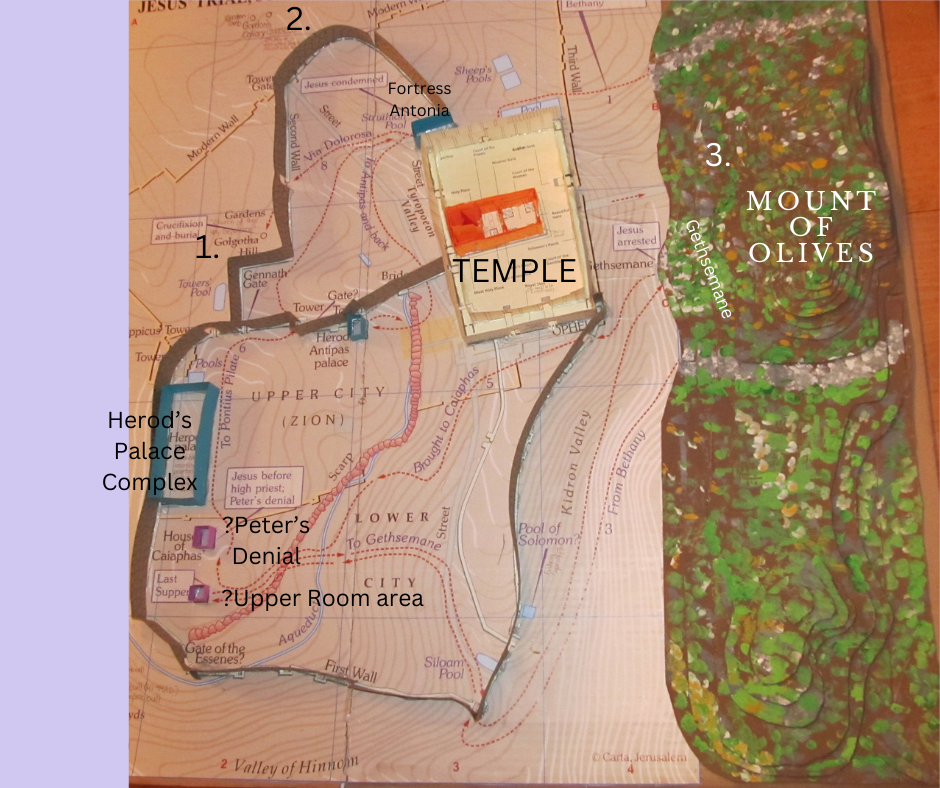
An archeological tidbit of info – An “upper room” is the opposite of a “lower room”. A “lower room” meant a room of burial. An “upper room” could be used as a synagogue (place of gathering to read the Bible) and/or a guestroom/inn for travelers such as those coming into the city for feast days.
The traditional place of the “upper room” is thought to be in the area of the tomb of King David, which is also not authentic according to archeology (e.g. Raimond Weill, 1913). The same archeologist instead found an upper room/lower room in a south section of the city near the Gihon Spring which was accepted as a possible location, for a period of time, before tourists reverted back to the traditional location.
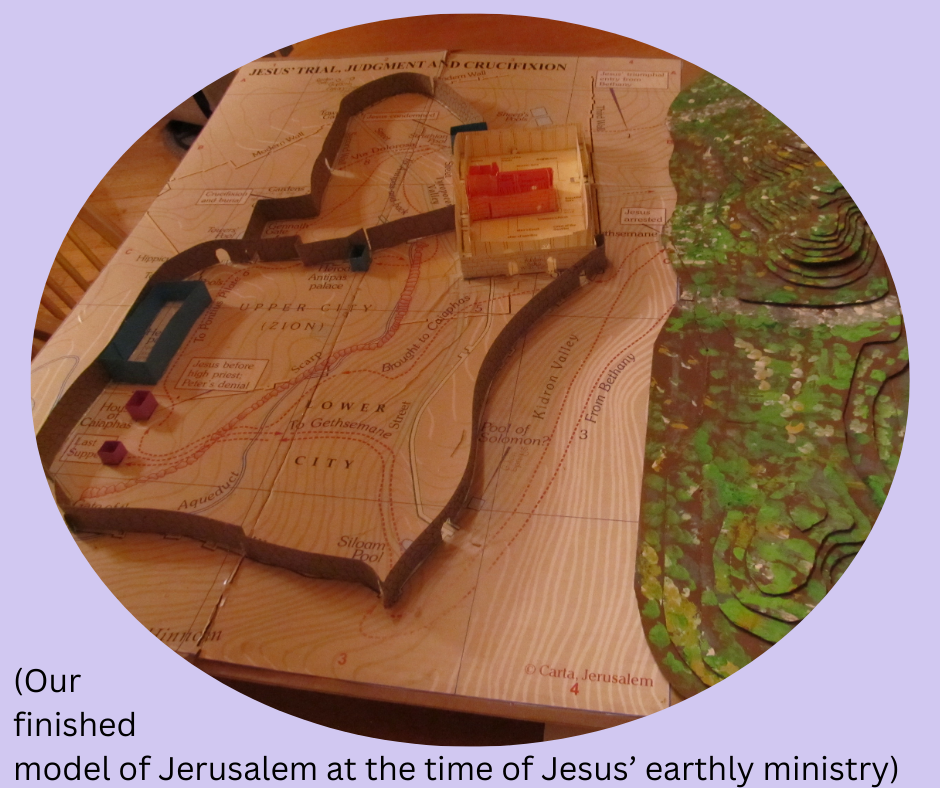
Due to the place being unknown or debated, our model has a “?” on the traditional site.
John 13-14, 15-17
(John 13:2 could be translated after supper or during supper. The context indicates it was the evening of the Last Supper.)
Humility
During Jesus’ last time spent with just His disciples before His death, He spoke of many special topics as He continued to show them the purpose of His first coming (Matthew 20:28, Mark 10:45) and loved them to the fullest extent as He gave His life for them (John 13:1).
Peter likely remember Jesus’ humility of washing his feet when he wrote 1 Peter 5:5-6 decades later. Guzik’s commentary mentions that the phrase in those verse 5 of “be clothed with humility” more literally could be translated, “wrap the apron of humility around yourself.”
A New Commandment – Love One Another
This has sometimes been called, “the 11th commandment”. Dr. Charles U. Wagner speaks specifically about it on an audio on our other website here: The New Commandment: The Plus Life.
Jesus’ Promise to Come for His Own
John 14:1-3 includes phrases commonly-understood by the people of that day to be part of wedding vows. (This would be similar to us hearing the phrase “for better, for worse…” in our culture and recognizing it as part of the vows of a wedding.)
This promise to go get His bride and bring her home to His Father’s house is for those who have trusted in Him as the Way to eternal life (John 3:16-18, 36). The New Testament uses this kind of symbolism for describing the close relationship of Christ to His own – Christ as Head, the Church as His body; Christ as Bridegroom, the Church as His bride.
Jesus’ Promise to Send the Holy Spirit
Jesus would not leave the believers in Him without guidance and comfort. God would continue to be them but it in a different way than they had known. The Holy Spirit descended to remain/stay with believers in Jesus Christ on the day of Pentecost. Dr. Wagner has also preached an excellent week of messages about the ministry of the Holy Spirit, which can be heard at our other website at this link.
(John 14:31 indicates that Jesus and His disciples then left the Upper Room and that Jesus continued teaching them as they went eventually to the garden of Gethsemane. See also John 18:1)
Jesus as the Vine
Jesus teaches His disciples about serving Him; He is their Master, Lord, and Friend, and the One Who enables them to serve Him. He reminds them to abide in Him in order to bear fruit, and to understand that those serving the world’s system will reject them like they have hated Him.
Jesus as the Victor
Jesus continued teaching about the work of the Holy Spirit. He also taught about sorrow turning into joy and of overcoming the world.
“These things I have spoken to you, that in Me you may have peace. In the world you will have tribulation; but be of good cheer, I have overcome the world.” John 16:33 NKJV
The Lord’s Prayer
John 17 is the longest recorded prayer of our Lord in the Gospels. (Dr. Wagner also preached about this chapter within his series on the Holy Spirit, mentioned earlier.)
In this prayer, our Lord prayed for unity for those who believed in Him. We are also sent to tell the good news of Jesus Christ. Jesus prayed for the Christians of our generation too – those who would hear the message of those original witnesses of His, years later (John 17:20) and would pass the word along to others.
“Sanctify them by Your truth. Your word is truth. As You sent Me into the world, I also have sent them into the world. And for their sakes I sanctify Myself, that they also may be sanctified by the truth. “I do not pray for these alone, but also for those who will believe in Me through their word; that they all may be one, as You, Father, are in Me, and I in You; that they also may be one in Us, that the world may believe that You sent Me. And the glory which You gave Me I have given them, that they may be one just as We are one: I in them, and You in Me; that they may be made perfect in one, and that the world may know that You have sent Me, and have loved them as You have loved Me.” John 17:17-23 NKJV
In the Garden and the Trials
After eating the “Last Supper/Passover meal”, Jesus and His disciples sang a hymn (e.g. “This is the day that the LORD has made. We will rejoice and be glad in it.” from Psalm 118) and went out to the garden of Gethsemane.
There in the garden, Jesus prayed, Judas betrayed Him, Jesus was arrested, and all the disciples fled.
John returned to watch Jesus’ trial and Peter was nearby and denied that he knew Christ before the rooster crowed three times.
The trials of Jesus are summarized well at this link.
I remember my dad teaching adult Sunday School and including monologues of characters in the Easter (or Christmas) story from the Back to the Bible ministry audios. Here is a link to their playlist called, “The Twelve Voices of Easter”. The monologues are also available on the Back to the Bible website in print (as a script), for example, Pilate. The people they portray are as follows:
- Judas
- Peter
- The Chief Priests
- Caiaphas
- Pilate
- The Mob
- The Thief
- The Centurion
- Joseph of Arimathea
- Mary Magdalene
- Cleopas
- Thomas
Song Suggestions
- Greater Love (Steve Green, kids’ song from Hide ‘Em In Your Heart Volume 2)
- No Greater Love – There are two different songs I have heard by this title:
- An instrumental song “No Greater Love”:
- “Verse 1: The love of friend and lover is often sweetly sung; But no greater love than the Savior’s love can be told by mortal tongue.
- Chorus: There is no greater love than that of Christ above, That made Him stoop to earth, become a man, And by his death provide redemption’s plan; There is no greater love, that’s why I’m singing of God’s love so rich and free revealed at Calvary; There is no greater love!
- Verse 2: With value more than money, Or jewels rich and rare; There is naught on earth of an equal worth, Oh, His love’s beyond compare.
- Verse 3: If He had died for angels or seraphim on high, We could understand, but amazed we stand that for sinners lost He’d die.” (by John W. Peterson)
- A gospel choir (swing-style) version of “No Greater Love”.
- An instrumental song “No Greater Love”:
- In My Father’s House (Steve Green, kids’ song from Hide ‘Em In Your Heart Volume 2)
- We Love Him (Steve Green, kids’ song from Hide ‘Em In Your Heart Volume 2 )
- A Towel and A Bowl (Steve Amerson)
- The Servant King (Maranatha! Music)
- Lead Me to Calvary (Lest I Forget Gethsemane) (hymn, Hussey)
- Tis Midnight and on Olive’s Brow (hymn, Bradbury, Tappan)
- Tell Me The Stories of Jesus (hymn, Crosby)
- My Saviour’s Love (I Stand Amazed in the Presence of Jesus…) (hymn, Gabriel)
- O How He Loves You and Me (Kaiser)
- What Will You Do with Jesus? (hymn, Jesus is Standing in Pilate’s Hall)
- I Will Give You All (Janet Paschal)
- He Was Rejected (Parschauer Sisters)
About “Celebrating Passover” –
I do not believe that the full feast of Passover must be celebrated by all Christians. But historically, it seems that many in the early church did continue to celebrate it, remembering the Lord Jesus as their Messiah.
- The “feasts of the LORD” are for the children of Israel (Leviticus 23:2 ff, Exodus 12:14ff) to continue to keep throughout the generations (“everlasting”, “perpetual”).
- As a Gentile who became a Christian, I was “grafted into” blessings God promised to the Seed of Abraham because I am “in Christ”, made right with God through faith, like Abraham was made right with God through faith (John 15, Galatians 3, Romans 4, 11). The connection we share is with Abraham and of course, with Christ; the Bible never calls Christians, a child of Israel (or of Jacob). Gentile Christians do not become Jewish when they become Christians. Jews and Gentiles who come to faith in Christ are both part of a new group (which began at Pentecost) called the “Church” (see Ephesians 2, 3).
- In the ancient Passover, the “strangers” (those who were not part of the covenant relationship) were not supposed to eat the Passover sacrifice, the lamb (Exodus 12:43-45, 48).
- In early church times, the feasts of Passover and Unleavened Bread illustrated that the Christian life was to be rejoicing in salvation and avoiding sin, delighting in purity and deliverance that trusting in Christ brings (1 Corinthians 5:7-8).
- Some Gentile Christians have participated in a seder meal with matzoh (unleavened bread), bitter herbs, grape juice, etc.; their reasons for why they can be included are to follow the example of Jesus and His disciples to remember the Lord on a special day and that there are references (e.g. to the Corinthian church) about this feast. See also verses such as Ephesians 2:12,19, Romans 2:28-29, Jeremiah 31:31-33, Acts 15:1-31.
- I do believe that participating in the Lord’s Supper, sometimes called Communion, is actually based on a part within the Passover celebration meal. And that portion of it is designed for participation by Christians, regardless of their heritage, in remembrance of the sacrifice of our Lord – because Jesus instructed His disciples to do so and the early Church, made up of both Jewish and Gentile Christians, also were to practice it (1 Corinthians 11).
- In Jewish households, all of the children in a family would eat and drink in the Passover meal including the little ones. A Passover Seder celebration was a time when parents used it to also explain to their children about the greatness of God, the sin that needs to be taken away, etc., as the children eat and drink in that meal. Children should be welcome to at least observe and learn from communion.
- No one is to eat and drink of it “unworthily” (1 Corinthians 11: 26-29). The Greek word translated “unworthily” means irreverently. It obviously is a good and Biblical reminder in teaching adults to tell them they should examine themselves to see if they are actually in a right relationship with the Lord. And I think it is also important to explain to children that they should not eat and drink unless they are doing so in remembrance of Christ. In other words, not to take communion irreverently (e.g. grabbing, laughing, taking it nonchalantly or lightly) or without thinking (which is meaninglessness) or in an effort to make oneself look good enough for heaven. It is faith in Jesus Christ that saves a person, not faith in items (Romans 10:3-4).
References
*Christ in the Passover by Ceil and Moishe Rosen, Moody Publishers, 2006, p. 69 (and the whole book).
** In Bible times, “wine”, if fermented, had a very low alcoholic content and was also significantly watered down further. It was not “strong drink”. Nor did it have the amount of alcohol that “wines” produced today – distillation wasn’t invented until years later. For a good reference on the Bible and wine, I suggest looking at materials by Norman Geisler. The words for wine served at Passover are “yayin” (Hebrew) and “oinos” (Greek) refer to any grape beverage including juice.
For aspects relating Christ to the Passover, I looked at a number of resources including the book I quoted from and a video series by Joe Amaral called “God’s Holy Days”, both which we’ve had as reference materials for a number of years.
Sometimes evangelical ministries such as ‘the Friends of Israel’ or ‘Jews for Jesus’ go through parts of a seder (with food on a table), teaching about the parallels of the Passover with the significance of Christ fulfilling the feasts. I saw such a presentation at my church as a teen. Sometimes those kinds of presentations can be found in video format.
See also to Part 1 (Reference section)