

To see the introduction of this post series, please go to Part 1.
PART 3 is about calendars and dates (background information and a chart for explanation).
As mentioned before, I realize there are varying opinions on the timing and place of Christ’s death and resurrection and I respect that. The main thing I want everyone to take from this little series is that our Saviour came “for this reason/purpose/cause” – He willingly gave Himself out of His great love for us!
But, since there are questions relating to the timing and I also said I would share some thoughts about those sorts of things, today’s post is about the topic of “when”.
The Day of Christ’s Crucifixion
Perhaps the simplest place to begin is the question of did Jesus die on a Wednesday, Thursday, or Friday. Tradition says “Good Friday”. Is tradition right in this situation? We think not.
About our foundation for figuring out what is right…
We need to remember that “tradition” might be true or it might not be true. How does this weigh in for determining what is true, correct, accurate? What do we have as good support to build on?
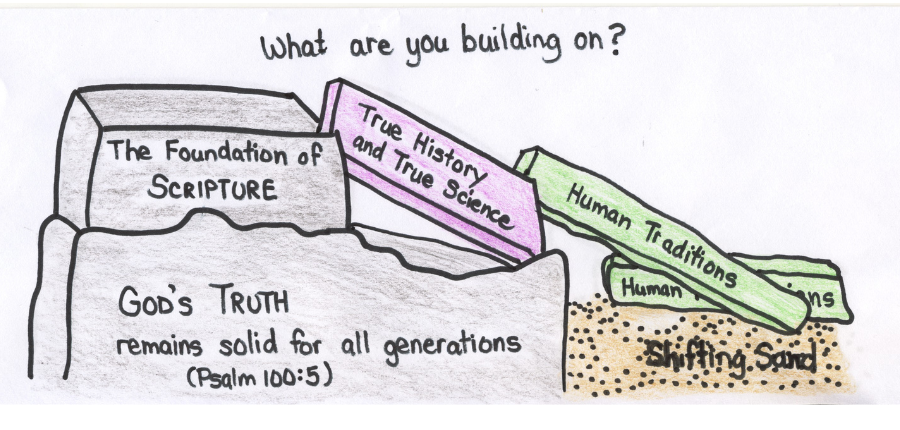
- Of course, for Bible-believing people, what holds the most weight is for if what we think/believe agrees with what the Scripture teaches us. We know for certain that God’s truth is revealed to us in the Bible. Scripture is all trustworthy and accurate.
- If Scripture is “silent” on something but there is tradition that has a basis in what history records for us, that has some weight to figuring out if something is accurate. (If human record of history and Scripture disagree, then of course, the human record is in error.)
- If both Scripture and history are “silent” on the tradition, then all that tradition is, is tradition. This goes for practices or ideas which were added over the years of church history (some of which can be good practices or ideas and some of which are not, but all they are, are traditions).
Let’s first look at what the Bible teaches us –
Jesus Himself said that He would be buried for the time period of “three days and three nights”:
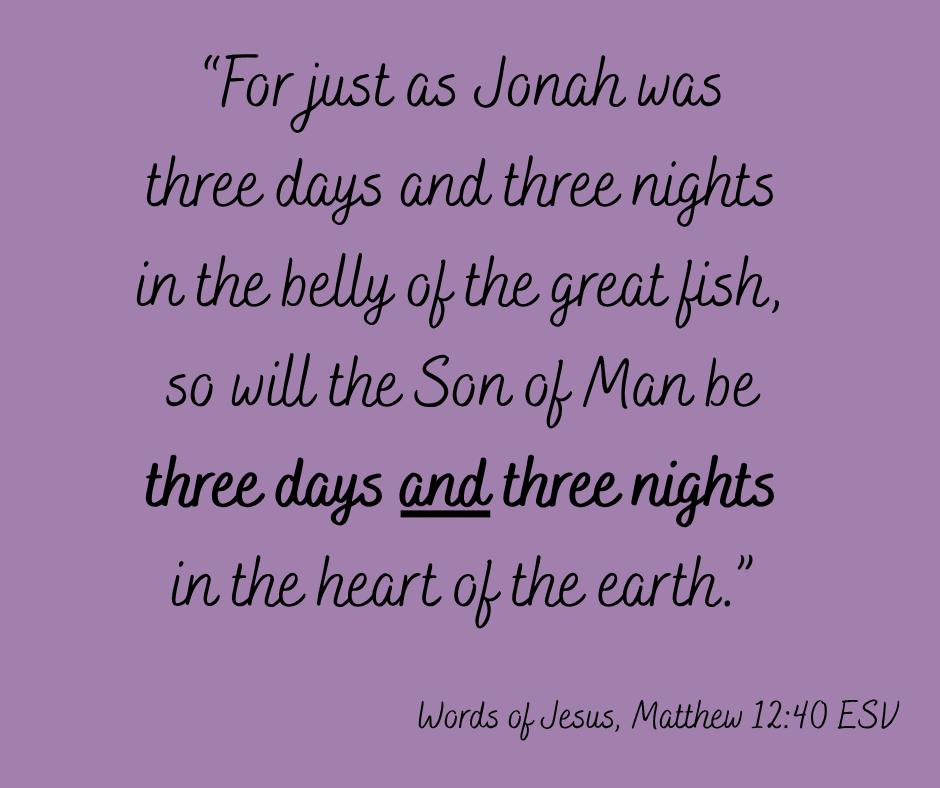
We know that Jesus’ resurrection took place before dawn on the first day of the week (Sunday). The tomb was already empty (Jesus wasn’t in there) by the time the angel rolled back the stone and the women came.
“Now the first day of the week Mary Magdalene went to the tomb early, while it was still dark, and saw that the stone had been taken away from the tomb.” John 20:1 NKJV (cf. Matthew 28:1, Mark 16:1, Luke 24:1)
Even tradition agrees with the Scripture on this – that Jesus arose on the first day of the week, on a Sunday.
If you have Jesus’ resurrection on a Sunday and simply count three days and three nights to get to that point, His death CANNOT have been on a Friday or a Wednesday!
- If Wednesday afternoon to Sunday “while it is still dark” – the number of days (or parts of daytimes) = W, Th, F, Sat. (4 days) and the number of nights = Th, F, Sat. (3 nights).
- If Friday afternoon to Sunday “while it is still dark” – the number of days (or parts of daytimes) = F, Sat. (2 days) and some people count early Sunday as a “day” (=3 days) and the number of nights = Friday into Saturday, Saturday into Sunday = 2 nights. The number of nights still makes Friday incorrect. The only way Friday can be right is to not agree with the words of Jesus as accurate to include the words “and three nights” (which most Christians would agree, is a bigger problem). Accurate Bible translations have these words. But manmade tradition often clouds over it and many people do not realize tradition for “Good Friday” isn’t correct.
- If it is Thursday during the day to Sunday “while it is still dark” – the number of days (or parts of daytimes) = Th, F, Sat. (3 days) and the number of nights = 3 nights (Thursday evening into Friday, Friday evening into Saturday, and Saturday evening until it is still dark on Sunday before it is Sunday daytime).
Does this point (of wanting to teach accuracy) really matter?
I think it can matter to an extent (even if it isn’t of most importance).
Not in the sense of “when to celebrate”. People can celebrate these facts whenever they’d like to. We have the liberty/freedom to do that with “special days”! (I can choose to celebrate on a Good Friday on an Easter weekend, even if it isn’t the same as a Thursday at Passover, which to me is rather a special time too.)
- Romans 14:5-8 (a choice to celebrate or not on certain days other people do)
- 1 Corinthians 11:24-29 (as often as you celebrate/whenever – to humbly remember Christ and what He has done for you)
- Colossians 2:6-23 (avoid empty traditions which distract you away from being rooted in Christ)
- 1 Timothy 6:3-5 (withdraw from worthless disputes and if someone is trying to explain away or twist the truth of God’s Word.)
But in the sense that if we are to be proclaimers of truth, then let’s do that, when we know it!
Furthermore, understanding that Christ fulfilled prophecy with accuracy and in detail (even His words in Matthew 12 of what was going to happen to Him), teaches us to trust that other Biblical prophecies about Him which have not yet been fulfilled, WILL BE, in their details as well!
Let’s next look at what history teaches us –
Essentially, the reason the timing (and sometimes places) are debated is because people rely on assumptions, tradition, and varied calendar systems to deduce or back-date. And this can get very complex, depending on “what” people trust or assume.
The Hebrew (Jewish) reckoning of days and nights is important since this was the culture Jesus was in at the time as well as what would be understood clearly to the original readers of Matthew, Mark, Luke, and John.
To be considered a “day” or a “night” in their week, it meant that any part of a day is considered a “day” and any part of a night is considered a “night”. It did not need to be the full day to be called a “day”. Many people understand this point.
But, it isn’t as simple as matching a Roman versus a Jewish calendar. There were variations within Jewish groups for calendars too.
When does each day of the week start?
By the time of Jesus’ earthly ministry, there was a bit of disagreement on this and perhaps this adds confusion to scholars, especially if they forget or ignore a couple of aspects.
Apparently, the Essenes used a different (solar) calendar system (Book of Jubilees 6:38). Sadducees favoured a morning start versus Pharisees who kept a sundown to sundown cycle. There would be variations of travellers from other regions for some feast days as to what might be emphasized more. (We can easily understand this for the feast of Purim as mentioned in Esther 9.)
But in this case, it doesn’t matter if history shows a variance. We don’t just have to pick a tradition from an opinion in history. We can figure out “which calendar” the Biblical record refers to:
- Go to Genesis 1 to see how God first described the days of the week and when each changed into the next day – “and there was evening, and there was morning, the ____ day.” First was evening, followed by morning.
- The Sanhedrin – those in charge of Jewish holy days and also part of the trials of Jesus – were Pharisees. The Pharisees, in this instance, also continued to follow the pattern of God’s Word.
The answer? Each day of the week began at sundown, around the time of the evening meal.
A “Passion Week” Chart
From that answer, let’s look at a chart I made to see this visually. You can also download a 2-page (free) pdf of it by clicking on the graphic or here.
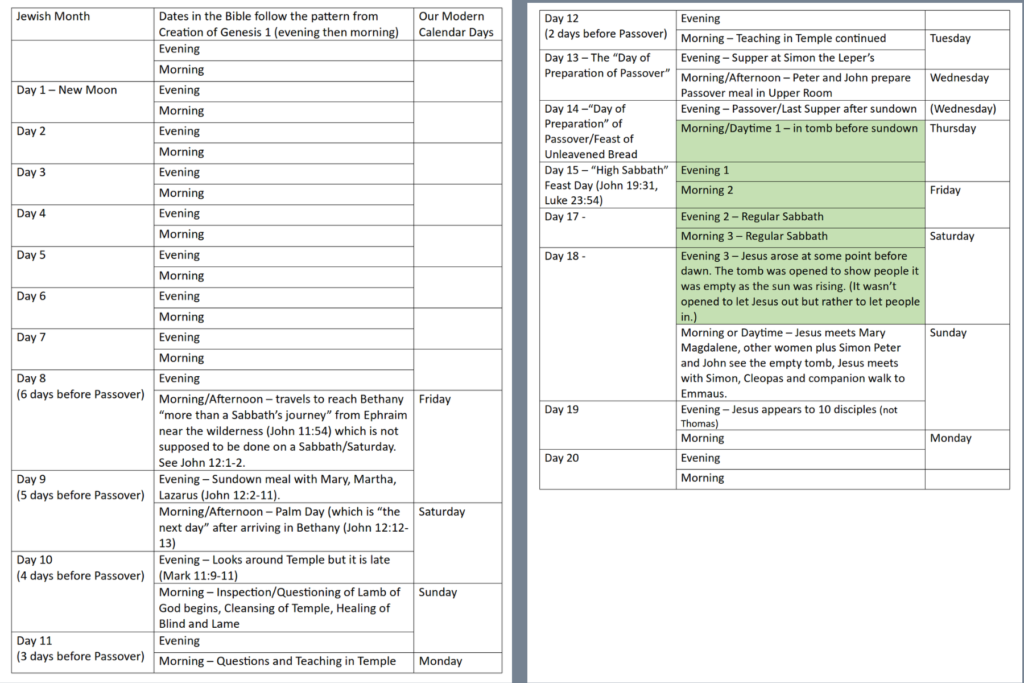
The Week of Christ’s Death – Passover
This section is about Christ’s death and its relationship to Passover celebrations.
(Years later, some professing Christians sadly became quite anti-Semitic in their worldview and did not desire to associate the celebration of Christ’s death and resurrection with the Jewish Passover. So the holiday we now know of as Easter, which blended in other traditions, began to be at least on some years, on purpose, to not coincide with the feast of Passover. I may write another post about the history and link to that here someday. But I’d like to keep this post focused and shorter. And more about Passover in Bible times will also be in the next post in this series.)
The Bible describes the work of Christ as the Passover sacrifice – Lamb of God Who came to take the punishment of sin on our behalf.
- “The next day he saw Jesus coming toward him, and said, “Behold, the Lamb of God, who takes away the sin of the world!” John 1:29 ESV
- “Abraham said, “God will provide for Himself the lamb for a burnt offering, my son.” So they went both of them together.” Genesis 22:8 ESV
- “Consequently, when Christ came into the world, he said, “Sacrifices and offerings you have not desired, but a body have you prepared for me; in burnt offerings and sin offerings you have taken no pleasure. Then I said, ‘Behold, I have come to do your will, O God, as it is written of me in the scroll of the book.’” When he said above, “You have neither desired nor taken pleasure in sacrifices and offerings and burnt offerings and sin offerings” (these are offered according to the law), then he added, “Behold, I have come to do your will.” He does away with the first in order to establish the second. And by that will we have been sanctified through the offering of the body of Jesus Christ once for all. And every priest stands daily at his service, offering repeatedly the same sacrifices, which can never take away sins. But when Christ had offered for all time a single sacrifice for sins, he sat down at the right hand of God, waiting from that time until his enemies should be made a footstool for his feet. For by a single offering he has perfected for all time those who are being sanctified.” Hebrews 10:5-14 ESV
- “…saying with a loud voice, “Worthy is the Lamb who was slain, to receive power and wealth and wisdom and might and honor and glory and blessing!”” Revelation 5:12 ESV
- “…Christ, our Passover lamb, has been sacrificed.” 1 Corinthians 5:7 ESV
Christ died at Passover in the daytime. (Matthew 27:15)
When was Passover? (Part 1)
And why it is not a simple as looking at one or two calendars or use a back-dating method…
- A new month began in the Hebrew calendar with an announcement from Jerusalem that a new moon had been just seen by the official eye-witnesses. (It is a lunar calendar system.) Numbers 28:11-15 mentions the offerings associated with it, 1 Samuel 20:5 indicates that by the time of Saul and David, it could be even an occasion for a feast (cf. Psalm 81:3).
- After the time of the Babylonian exile, it became at least occasionally so, that there could be “double-day” holiday observances because people lived further distances (different cloud cover perhaps) from official announcements of a new moon.
- Additionally, for the month of Nisan (which is the month when Passover was celebrated), another factor was “if” the barley harvest was ripe enough to begin yet. If barley wasn’t ready, the start of counting was delayed. This was because barley was needed to count from for Firstfruits (another feast within the feast of Unleavened Bread) to wave and count up to the Feast of Weeks/Pentecost) (cf. Leviticus 23, Deuteronomy 16).
- They occasionally threw in leap months too; this was because they had to adjust the moon cycle for agricultural seasons for spring and fall festivals.
- There was also, by the time of Jesus, a blending of the terms “Passover” which was pretty much synonymous with “Feast of Unleavened Bread”(e.g. Luke 22:1), similar to how we use Christmas to mean not just one day, but a break of several days.
- There also could be two Sabbaths in one week, as is actually mentioned within the account of the “week in this study “Passion Week”.
Information in history records might not actually be significant for finding answers:
- There is mention many years later, that there was adjustment possible if Passover naturally came on certain days of the week (e.g. Monday) that they’d move the celebration to a different day of the week instead – were those laws followed in the first century too? We don’t know but I think it isn’t actually significant information for this.
- And then, there is the fact that historical records would also have been destroyed in the burning/destruction of Jerusalem in 70 A.D.. While it’s true we have some historical information written in the Dead Sea Scrolls and Josephus, etc., we must remember that only the Bible is ultimately trustworthy to be preserved in whole truth. Josephus was not infallible to begin with but, the earliest copies of his writings are about 1000 years later, and copied by monks who may have inserted portions to fit their traditions. So what he (or his copyists) have to say about Jesus may be interesting but it may not be always accurate.
- Sometimes in this “calendar” debate, there are statements about “which part” of the gospel accounts are “accurate” – like ‘should we trust Matthew or is John correct instead?’ The right perspective is both of those books in the Bible are correct, because it isn’t just human authorship (2 Peter 1:21). We should remember ALL of the Bible is true and trustworthy, not just some parts.
The reason I believe “Thursday” and “at Passover” is accurate is based on what is mentioned in the Bible, not because of some history lesson or tradition.
- To me, it doesn’t matter if an extrapolated kind of calendar matches something in the story or not – you can find someone say that there isn’t any Thursday 14th Nisan in the “right” year, others say there is a Thursday on 29 or 30 or 32 AD.
- In other words, I’d say just keep to the Biblical text and don’t worry about the various “calendar systems” which try to back-date based on their collection of assumptions. Some back-dating will be accurate but others will not be, based on what the assumptions are.
God knew the perfect timing for the year He chose and looked after when Passover was. Most likely there were those who recognized the timing back in the time of first century (John 11:49-52, Acts 6:7), similar to Daniel recognizing what time period he was living in when he read Jeremiah (Daniel 9:1-2, Jeremiah 25:11, 29:10) and the wisemen realizing it was getting to be the time when the king of the Jews would arrive (Matthew 2:2, 10).
What Year?
With questions as to “what year”, Jimmy DeYoung talks of the reference point of Daniel 9:25 and Nehemiah 2:5, 8 for when the countdown begins – from the decree to rebuild the city walls (not the command to rebuild the Temple, which is a different year) to the point when Jesus overlooked Jerusalem from the Mount of Olives, weeping for it at the beginning of the “Passion Week”. The prophecy of the Messiah being “cut-off” (His earthly ministry for that time, finished/completed) would happen before the the Temple was destroyed again and the Jews dispersed again. If you are interested into digging deeper into these sorts of things, you may like to look for Jimmy’s audio messages called “The Passion and Prophecy”.
Updating this post with a quick summary on this:
- Both the solar calendar (which is used for referencing to historical events and degrees of kings (government)) and the Jewish calendar of 360 days (not all lunar calendars are the same) are used to figure out “what year”.
- If the countdown begins in Nehemiah 2 (and I believe it does because that degree is about the rebuilding of the walls of Jerusalem), that year is 445 B.C.E. in historical records.
- There is no year zero between B.C.E. and C.E. (B.C. and A.D.) so when adding the years up, you have to minus 1.
- For example, the number of years between 445 B.C.E. and 32 C.E. = 445 + 32 – 1 = 476 years on a solar calendar. (That part is very easy to calculate. The rest is a bit harder but still not that difficult.)
- 476 years (solar) = 476 x 365 = 173, 740 days (Don’t worry about figuring in leap days yet. We can take care of the “extras” in the lunar side. There were 365 days most of the time and then beginning in Roman times, every fourth year had 366 days. So there wouldn’t have been many leap days yet by this point. They used 365 days/year for general calculations so we should too for this.)
- How many years in the Hebrew calendar would 173, 740 days be? Convert it into 360 days/year.
- 173, 740 divided by 360 = 482.61111 years. We can round that to 483 years on the Hebrew Calendar. But, some people have also at this point, added in the leap month adjustment (of 116 days) and a few weeks from the degree in 445 B.C. being in March versus Passover being in April in 32 A.D. to come up with the adjusted days of 173, 880 days. When that is calculated (173, 880 divided by 360), it is exactly 483 years. (Source link of a page of writing instead of an audio)
- There are 483 years on the Hebrew calendar between Nehemiah 2 and the prophecy in Daniel 9 about the Messiah being “cut off, but not for Himself” (i.e. rejected and executed on behalf of others at a time before Jerusalem would be destroyed by the Romans).
- To put 483 years into groups of sevens, which is the language of Daniel’s prophecy, we can easily calculate this to 483 years divided by 7 = 69. In using the language of Hebrew calendar years, there are 69 groups of sevens from Nehemiah 2 to when Christ travelled in ministry throughout Israel, was rejected by both Jewish and Gentile leaders, and suffered on behalf of the world to die for our sins as the Lamb of God!
- There is no year zero between B.C.E. and C.E. (B.C. and A.D.) so when adding the years up, you have to minus 1.
The Death of Christ and What It Accomplished

While the “timing” is a point of interest and it has importance when understanding details, as I’ve mentioned before, the reason of Christ’s death is far more important to us.
This is link to a sermon from my dad years ago by this title and we encourage people to listen to that audio too: The Death of Christ and What It Accomplished | The Word In Our Hearts (There is a free downloadable printable on that same page that I did for children as well.)
Song Suggestion
References:
Please refer to Part 1’s post.
Also, https://www.gotquestions.org/three-days.html and https://reasonsforhopejesus.com/crucified/ summarize the debates in a very readable manner while aiming to keep more to the Biblical text, in comparison to some websites.
Also, about the three days and three nights, there is an audio sermon by Dr. J. Vernon McGee about Jonah at our other website: Jonah – Dead or Alive? | The Word In Our Hearts