
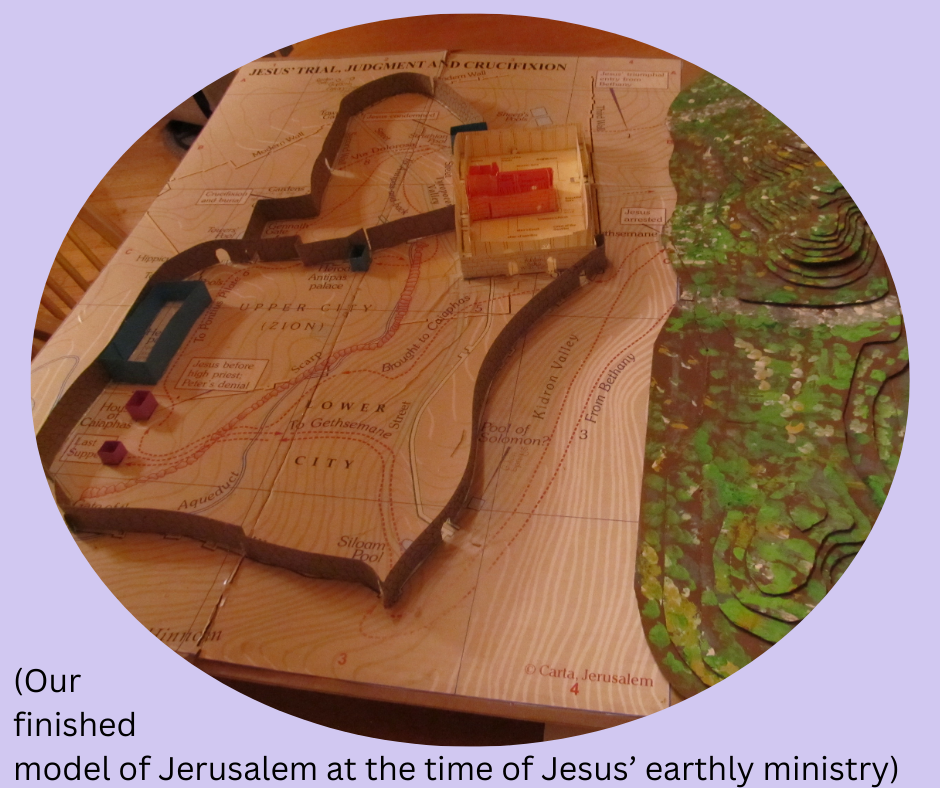
This post series is about remembering and celebrating what Christians usually call “Easter”. It includes thoughts about what the Bible tells us, some related historical background information, song suggestions, as well as pictures of how I taught this topic with my children in the past when we built a model of Jerusalem to show some of the “where” these events happened.
This series is divided as follows:
PART 1: An evening meal at Bethany and the Triumphant Entry into Jerusalem (i.e. “Palm Sunday”, which I personally now think was “Palm Saturday”)
PART 2: The fig tree, Jesus cleansed the Temple area, and His teachings.
PART 3: About calendars and dates (background information and a chart for explanation)
PART 4: The Last Supper, Passover, Feast of Unleavened Bread and in the Garden and Trials of Jesus
PART 5: Jesus’ Death and Burial
PART 6: Jesus’ Resurrection and The Good News!
Part 1: An evening meal at Bethany and the Triumphant Entry into Jerusalem
This first part contains my introduction and sections relating to the beginning of the section of final days before Jesus died on the cross and rose from the grave.
Introduction – “For This Cause”
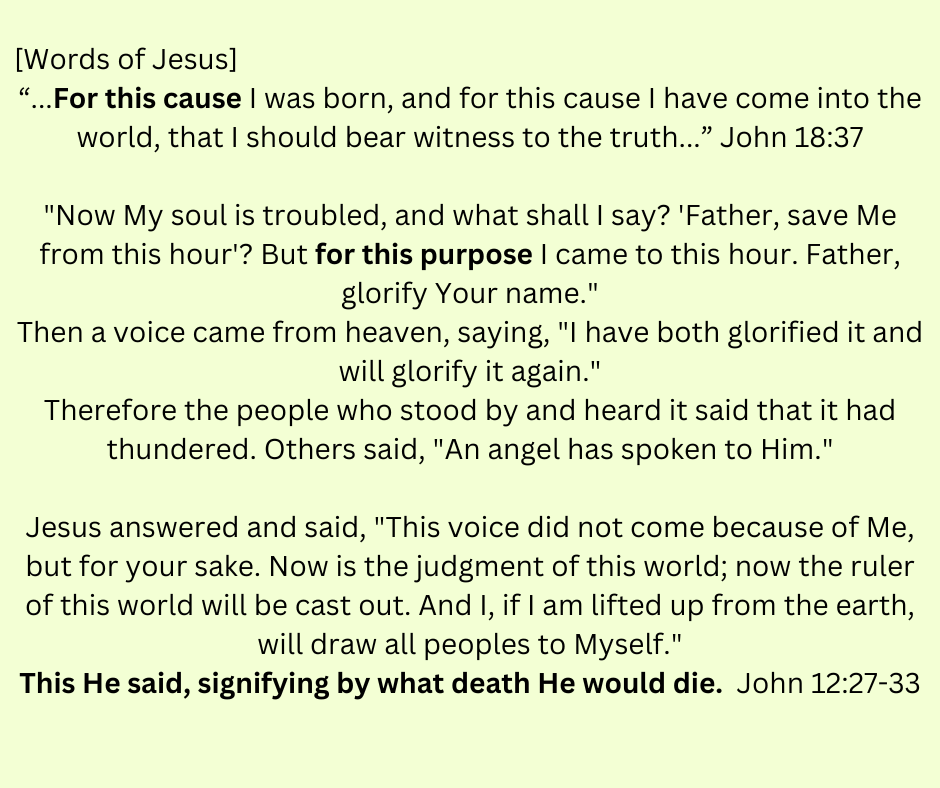
I realize there are varying opinions on the timing and place of Christ’s death and resurrection and I respect that. I’ll give my thoughts on these things too. But the main thing I want everyone to take from this little series is that our Saviour came “for this reason/purpose/cause” – He willingly gave Himself out of His great love for us! We worship Him because He is worthy!
Friday – The evening meal at Bethany
John 12:1-11 – the evening supper where Mary (Lazarus’ and Martha’s sister) poured out her expensive fragrance and anointed Jesus’ feet with it.
This was six days before the Passover. Some believe this supper was the special weekly evening meal which begins a Sabbath (and I’m inclined to think this is so as well).
Sabbath begins on Friday sundown and goes to Saturday sundown. The cycle of the Hebrew week goes first night, then day, as per the pattern given in Genesis 1. Our common understanding of “days” begin first with night (e.g. at midnight) and then days. The “first day of the week” for both though remains Sunday.
A song like to listen to when we talk about this story is Steve Green singing “Broken and Spilled Out” (written by Gaither’s) which describe this story too. Here is a link to the audio: Broken and Spilled Out.
Saturday – Triumphant Entry into Jerusalem
Here is a song from “His Word in Me” with hand motions: The song is called, “This is Jesus” .
“Palm Saturday”/”Palm Sunday” – I personally now think it was a Saturday when I understand the background more but we also take time to remember it on a Sunday when we meet with other Christians.
I like having our kids make paper palm branches and singing various songs about this special event!
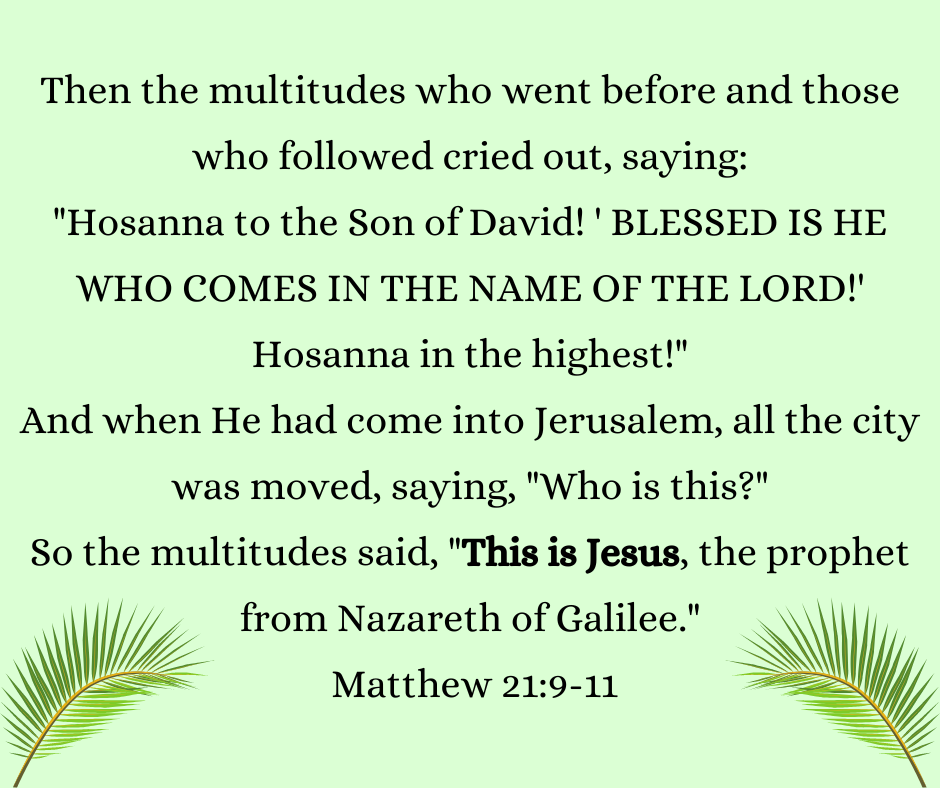
John 12:12 says that “the next day”, after the supper with Mary, Martha, and Lazarus, people gathered to wave palm branches and welcome Jesus into Jerusalem as the Messiah (“Son of David”).
For His first coming to earth, Jesus entered the city on a donkey, because the purpose of this coming was to save, not to judge.
However, the Bible also tells us that someday Jesus will return, but the next time He will be on a horse, getting rid of evil and setting up His kingdom in victory to reign from a throne in Jerusalem (see Revelation 19-20 alongside Zechariah 14, Ezekiel 43:6-7, Daniel 7:13-14, etc.).
In Bible times, if there was a leader coming into a city on a horse, it meant to the people that he was coming as a conqueror but if he instead mounted a donkey, it meant he was entering with a message of peace to the people.
Psalm 118 was one of the songs sang at the Passover meal (which would be in just a few days). If you read that Psalm, you can find the same words the crowds shouted as well. Psalm 42 is also a psalm related to remembering a feast day.
Three times a year, Israelite males were to re-gather in Jerusalem (Deut. 16:16) and Passover was one of those feast days. 1 Cor. 5:7 calls Christ, our Passover Lamb. Exodus 12:3 gives instructions to the Israelites to choose their lamb (e.g. inspect it for perfection and pick it out) on the 10th day, in preparation for the Passover a few days later. Some people understand this “picking out” of the Lamb being the same day as the day when the crowds shouted, “Hosanna”.
The word “Hosanna” literally means, “Save us!” although in the crowds’ mind, they were looking forward to time when the Messiah would gain victory over the world including the Romans and reign in righteousness and peace in fulfilment of God’s promises.
They did not remember that the Messiah needed to also die on behalf of sinful people first (Isaiah 53).
Additional thoughts about the Triumphant Entry –
- As Jesus rode on the colt and approached Jerusalem, He was very saddened about the general response of the nation (e.g. most of the leaders) who had rejected their Messiah (cf. John 1:11-12). Luke 19:41-44 It appears this wasn’t the only time He wept about this but this is part of that journey. (This was despite the large crowd who were praising Him. He still cared, like the Good Shepherd seeking one lost sheep in a flock of 99 in a fold.)
- Psalm 113-118 (the Songs of Ascent – “going up” and Jerusalem is across a valley and then “up” on a hill) and the “Pilgrim Psalms” (Psalm 42, 84, 122, 133, 134) would be familiar songs to sing at this time of year by travellers, etc.. The phrases they sang that week can be found within these Psalms.
As far as population goes, some historians estimate around 600,000 people normally lived in that area with perhaps the population swelling to around 2 million around Passover time. A portion of those were in the crowd waving palm branches, etc.. But when they reached Jerusalem, the Bible says that the “whole city” was stirred and wondered “who is this”. (Matthew 21:10-11). - Re: Gates – This leads me to believe that they did not enter via the Eastern Gate, as “tradition” would put the path. (“Tradition” is sometimes based on ideas a few hundred years later without a historical or solid Biblical base.)
- For sure, it was not the “Golden Gate” since that gate didn’t exist until much later. (That one apparently is “on top of” the Eastern Gate which is buried.)
- The idea that the Messiah entered that gate and then it was shut up/blocked is a popular tradition due to spiritualizing Ezekiel’s vision of the kingdom Temple (because that passage literally does not match descriptions, e.g. Ezekiel 44:1-2 and surrounding chapters). * See also bottom of post.
- Additionally, the “Eastern Gate” (also called the Shushan Gate) in the time of the Bible, was not a public gate for crowds to use – instead it was used by the priests and their assistants to take out the scapegoat and the heifer’s ashes “out the gate”. There is mention of a causeway in history (likely a wooden boardwalk used when needed, no archeological evidence for a bridge with arches) to get over the valley (including the graves).
- The “Eastern Gate” was the only gate on the side facing the Mount of Olives by the time of Herod. (History book – Mishnah Middot 1.3 gives this info as well as I think Josephus’ writings.)
And it was a gate that went directly into the Temple area, not the city (thus, is considered a “temple gate” instead of a “city gate”). So if the “whole city” noticed the crowd, I think they entered through an actual city gate. - There are two other gates people have considered – a route coming in on the north side and then through the Sheep Gate into the Temple courtyard. That was the gate the lambs were brought through for sacrifice as well. But that gate was also very close to where Pilate’s crew were standing guard so some think that getting that close to them with a large crowd would have invited major trouble. (That is, unless the soldiers were also intrigued instead of concerned at someone being announced as “king”.)
- The south side entrance would come shortly after walking along the Kidron Valley and then towards the common entrance of the Huldah Gates/Stairs. Some think that is more probable.
- Really, we can’t say “what route” they took into the city other than “tradition” is not always accurate so we should hold to those parts of the account “lightly”. They did for sure come from the direction of Bethany/Bethphage/Mount of Olives. While Psalm 24 speaks of the future things as well, it mentions “gates” (plural) – in other words, Jesus can choose to enter through any gate He wants to.
- After Jesus came to the Temple, that day of palm branches waving, it was “later”. City gates would close around sundown so if He and the disciples were staying again in Bethany (e.g. at Lazarus’ or Simon the Leper’s house or another friends’ house), they’d want to get out in time. If this was on a Sabbath, the market wouldn’t have been selling things there anyways since that would be against the law. In the Gospel of Mark, we learn that Jesus went into the Temple area and simply looked around and then went out. The first time Jesus was in the Temple that weekend was not the cleansing of the Temple. That cleansing happened the next day, according to Mark.
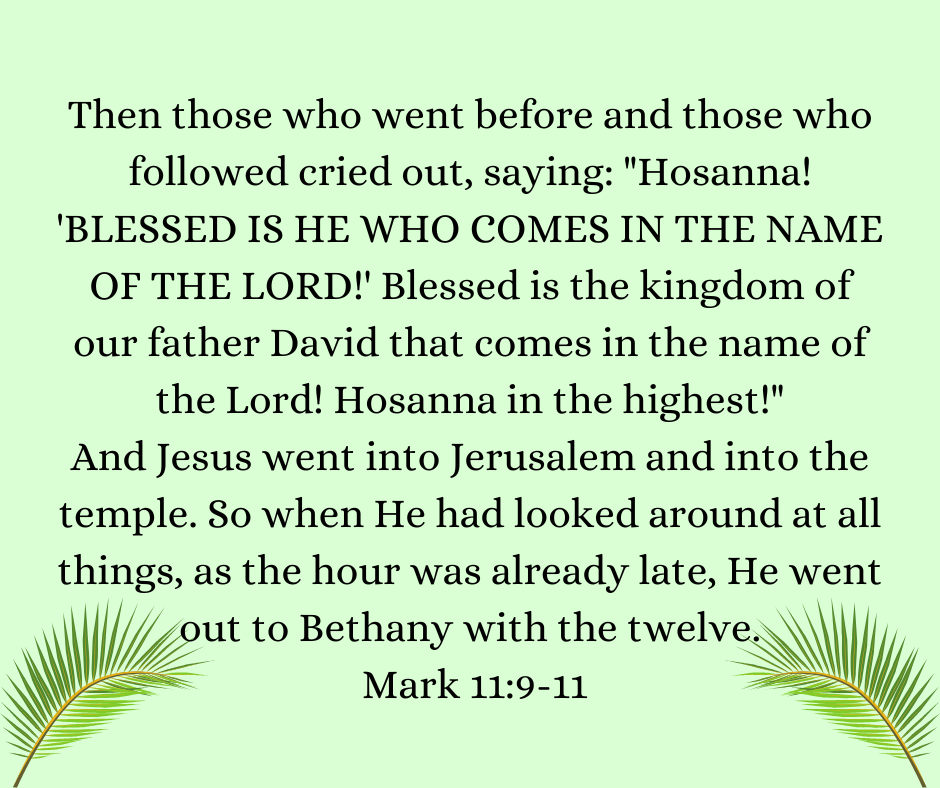
“Then those who went before and those who followed cried out, saying: “Hosanna! ‘BLESSED IS HE WHO COMES IN THE NAME OF THE LORD!’ Blessed is the kingdom of our father David That comes in the name of the Lord! Hosanna in the highest!” And Jesus went into Jerusalem and into the temple. So when He had looked around at all things, as the hour was already late, He went out to Bethany with the twelve.” Mark 11:9-11 NKJV
*Further note about the Golden Gate – When the Messiah (Jesus Christ) comes to Jerusalem again, He will be coming from the east/for the Mount of Olives – Zechariah 14:4, Matthew 24:27. No gate will keep Him out! One thing that will happen at that time will be a rather large land shifting to instantly create a valley by splitting the Mount of Olives so that area will experience some major changes.
But the Golden Gate (which Jesus never entered on Passion Week because it wasn’t built then) which is shut up now is not a fulfilment of Ezekiel’s vision. It is interesting to note that those who shut it apparently did so because they want to “keep out a false Messiah (an anti-Christ)” and that makes me wonder if the gate will be involved in trying to prove his legitimacy when he appears and is accepted by the nations. But my point really is, that Ezekiel 44 is not connected with “Palm Sunday” other than the broad, “nothing can keep the LORD out where He decides to go”.
Other Song Suggestions
You may be able to find these online or in songbooks:
- “Down From His Glory” (a Salvation Army hymn)
- “Across the Lands” (Getty/Townsend)
- “In the Name of the Lord” (Blessed is He Who Comes…)
- “Hosanna! Hosanna!” (a chorus sometimes also titled “Lord, We Lift Up Your Name”)
- “All Glory, Laud, and Honor” (a hymn)
- “Hosanna, Loud Hosanna” (a hymn)
References for this series:
Some of the points mentioned above and in this series were found in common sources such as encyclopedias, typical commentaries, or similar general Bible reference materials. Other points were specifically brought to our attention from the ministry of Jimmy DeYoung, a Bible teacher, researcher, news reporter, and resident of Jerusalem for many years. His personal testimony can be viewed here. Our family has learned much from him since my teen/young adult years and he is home with the Lord.
The base map that we used for our model is produced by Carta Jerusalem and is part of this set of maps which could be purchased through Christian Book Distributors (our affiliate link). Note: The last I checked CBD’s website, they did not offer the same product at the present time. However, it may be offered in a similar wall chart set by this same publisher or perhaps it will again become a product there in the future. The set (of 10 maps) that I personally have is called, “Carta Wall Maps – Jesus and the Apostles” with the map we used for the model which is entitled, “Jesus’ Trial, Judgment and Crucifixion”. ISBN: 978-965-220-903-0.
We glued it to a blank presentation board (which is something a dollar store or office supply store may have). We also used cardstock and corrugated boxboard and paint to add 3-D portions to our model.