
This is a post about natural and artificial forms of emfs – electromagnetic frequencies. It explains the sections within the EMF spectrum diagram.
It includes both information source links and links of interest – to go on to study related topics on other websites (such as about animals which have special electrical features or about the human sleep cycle).
We hope you will enjoy this study!
Resources Available
- To learn about this topic, it is very helpful to print out or at least open in another tab, the provided EMF spectrum diagram.
- Keep the diagram near you to help you see the “big picture” as you read the details in each section.
- Teachers/Parents/Others: The content of this post ALSO has been put into a printable book format! In a sense, it is easier to read because it has more “white space” in the formatting. But it also provides another option – instead of teaching one longer science lesson, it can be 15-18 lessons as a unit study, and it is broken down into the sections to make this easier to teach. And, the printable format has an added feature – activity pages for lower-levels (e.g. kindergarten to junior age students) on the same or complimenting topics! It is a multi-grade curriculum book that can help for learning science concepts such as physical properties, how electricity is produced, magnetic forces, etc. Here is a link to our product page in our shop: Electromagnetism and Related Topics in Your World: A Science Unit Study for K-12+.

(Note: Links for websites, including videos, may lead outside of our PSLC website. While these links led to appropriate addresses when this post was developed, given the changing nature of the internet, we cannot guarantee that the links will lead to the same content in the future. As we always encourage, please use parental wisdom and discernment when accessing online content.)
About the Diagram
If you search online for “electromagnetic spectrum diagrams”, often the images leave out the details in the portion(s) of the spectrum which I want to explain in this post (e.g. source link for typical diagrams). But I wanted to base mine on the more-detailed scientific ones understood by physicists, engineers, electronics people, such as what was being used in a course I was taking. (That secular course was designed for the sake of electricians or others who wanted to understand Faraday caging, fix wiring errors, and similar. It is mentioned on our weblinks page. Some of the content below was taught in a few of the lessons.) Another website that shows a similar diagram with a detailed chart is at this link.
Below is my drawing of an electromagnetic spectrum to help explain the categories of physical energy within the spectrum (of both natural and artificial forms of the mostly-invisible frequencies and wavelengths).
I have simplified it to not draw in the wavelengths as well as a portion of the larger numbers. Instead, I will just refer to the approximate sizing at times to describe those. I wanted a diagram that was relatively easy for ordinary adults and teens without a math/science background to understand, and something with fewer numbers and lines to look at.
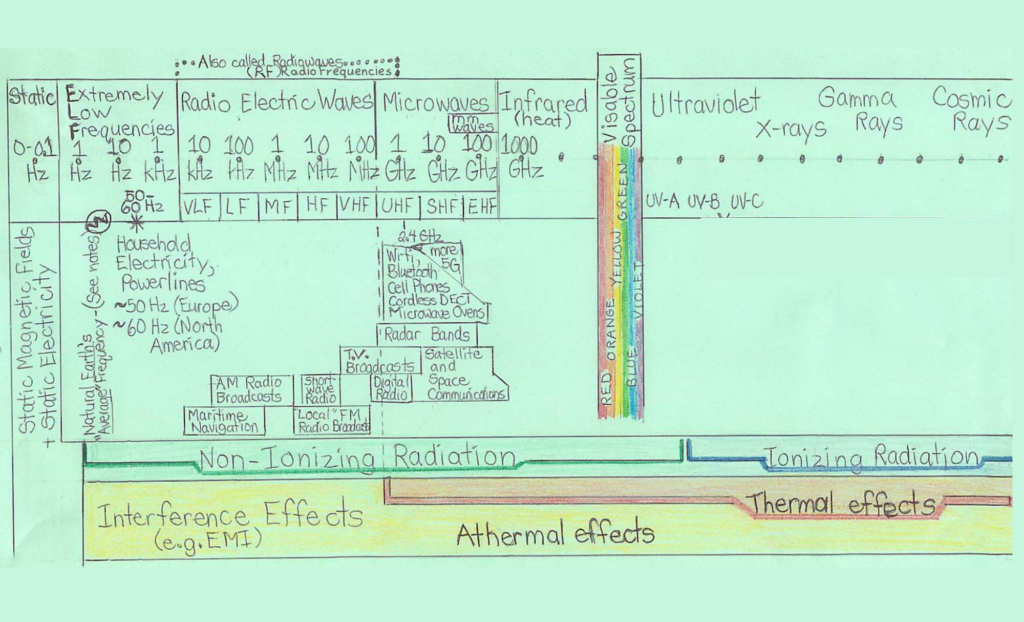
A reminder: To download this diagram (but with a mostly-white background (instead of green)) to help people follow along with this post, here is that link again: EMF Spectrum to Print. (It is a free pdf.)
The other printable resource that you might find of interest are the diagrams on pages 11 and 16 (and maybe pages 19-21) of the Acoustimeter manual which can be downloaded here: Acoustimeter Manual.

Table of Contents
Introduction
EMFs is an acronym for electro-magnetic frequencies.
Natural EMFs
It is important to understand that there are significant differences between NATURAL and ARTIFICIAL forms of EMFs!
Balanced…
The natural forms were created in an excellent balance for how much/how strong these emfs affect our lives on earth. God is the Creator of the heavens and the earth and His wisdom is perfect!
Astronomers sometimes nickname our planet as “The Goldilocks Planet” – “just right”, not too hot, not too cold!
Natural emfs include things such as the radiation from the sun, the magnetic north and south poles on our planet, lightning strikes, electrical signals within the bodies of living organisms, etc.. (Another post about Some Benefits of Sunlight is to be linked here when it gets posted.)
But a main point I want to make here is that natural emfs, most of the time, are not as concentrated in strength/power where we are, which is on Earth.
Instead most natural emfs are very mild to us in comparison to the strength/power of manmade emfs that we have added to our environment where we live in recent decades. (One of the exceptions would be a close lightning strike which of course, is natural and very strong. But in general, people are sheltered from such.)
Furthermore, natural emfs are not “pulsed” in order to carry information like the manmade emfs can be in communication devices.
From the sun…
Are the EMFs from the sun powerful? Absolutely!
But, at the large distance away from the sun that our planet rotates (around the sun)
and, with the shielding provided by the layers in our atmosphere above us,
most of the invisible portions of the sun’s rays (radiation/emfs) do not reach the surface of the earth where we live!
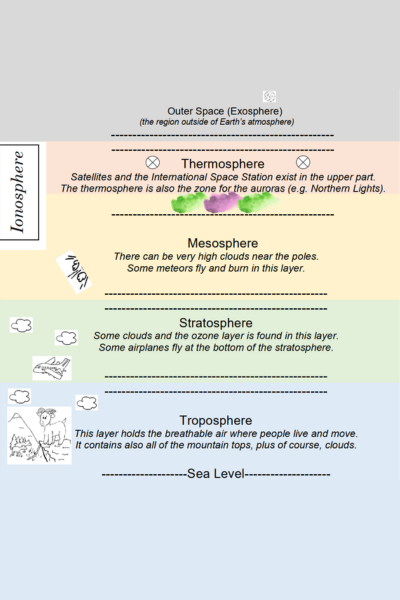
Here is a diagram showing the layers of our atmosphere:
God has provided one, the atmosphere, and two, the Earth’s magnetic field, to shelter us from getting too much of the sun’s radiation!
Here are a couple of source links for learning more about what kinds and how much of the sun’s radiation reaches us on the earth: Link 1, Link 2 (similar info but simpler to read).
From those website diagrams we can learn that:
- 99.9% of solar radiation that reaches where we live is within the categories of infrared to UV light (from 200 to 2600 nano-meters).
- Approximately 42% is visible light that we use to see colours and light.
- Around 5% to reach into our atmosphere is ultraviolet but most of that is absorbed by ozone (in the stratosphere).
- About 53% is the infra-red radiation, which provides heat for us.
(You might like to sketch one of those diagrams/graphs to help you remember this.)
Something to keep in mind:
Wireless technologies use manmade frequencies in the microwave, radiowave, and ELF categories. People who say that the sun produces more microwave radiation frequencies which reach us on Earth at a higher-than-cell phone level are badly mis-informed.
The reality is that we are shielded naturally from almost all of the sun’s microwave, RF, etc. frequencies here!
(To read about the atmosphere in general, you can learn more at this link. And to learn more about the ionosphere, here is a link. I like to ask my students to draw a labelled diagram of the atmosphere.)
The Electromagnetic Spectrum – Terms
Here are some basic definitions of terms used when talking about the electromagnetic spectrum:
VISIBLE: This describes what we can see with our natural eyesight. A small portion of the EM Spectrum is visible, seen as light and colour!
INVISIBLE: We cannot see invisible things with our natural eyesight. However, measuring tools (e.g. gaussmeters, RF meters, etc.) have been invented to be our “eyes” (and “ears”) to helps us understand the existence and characteristics of invisible physical energy. Common examples of invisible physical energy include the magnetic field forces of magnets, electrical currents, and heat energy.
- An aside note: If “it’s invisible” but doesn’t fall into agreement with the already-known laws of physical science such as being able to be measured objectively, based on knowledge that is true universally, then it can’t be called real science. (I’ve countered some of the ideas of this falsely-called ‘science’ in my posts here , here, and here, as well as quantum spirituality at this link.)
ELECTROMAGNETIC ENERGY: A good definition is: Physical energy which has particles travelling in a wave-like pattern at the speed of light.
- Specifically, these kind of waves (electromagnetic) “consist of electric and magnetic fields which exchange energy as they move through an electrically insulated material or through empty space.” (Source of definition: Young People’s Science Encyclopedia, Volume 19 (Ve-Zy): “Wave”, p. 1837, National College of Education, Children’s Press, Illinois, 1978.)
- In theories (not laws of science) of Lewis and Einstein, the term “photon” is known as a little “packet” of physical energy. It is thought to travel at the speed of light. But technically, it is considered as a carrier of light or of any kind of physical energy that radiates, rather than light itself.
The amount of energy found in these particles vary (e.g. depending on their wavelengths) with gamma rays having various higher energies while the radiowaves have less amounts of energy, etc.. (The spectrum diagram shows sections from low to high energy, left to right.) Electromagnetic energy has both particle and wave-like characteristics acting simultaneously.
(If this physics topic is interesting to you, you can learn more about the basics linked here (which has drawings) and here (a video that has moving diagrams and also explains modulation).)

FREQUENCY: This is the measure of how many waves (or cycles) pass a certain point every second when measured in Hertz (Hz). One example to understand frequency is looking at water waves at a beach and counting how many peaks pass the end of a dock (or reach the shore) each minute. You can also think of it as how often something gets slapped – a high frequency means the dock gets slapped more often so could get broken sooner.
But a low frequency doesn’t mean that the dock doesn’t get slapped (impacted negatively) with waves! It simply means it gets hit fewer times within that period of time.
A low but sufficient frequency CAN still cause damage, but it’s more likely to do so by gradually weakening the dock until it eventually begins to break down. Then, once it begins to break down, continual slapping will become more noticeable damage.
Plus, different specific frequencies sometimes have a few different properties (characteristics) for how they behave.
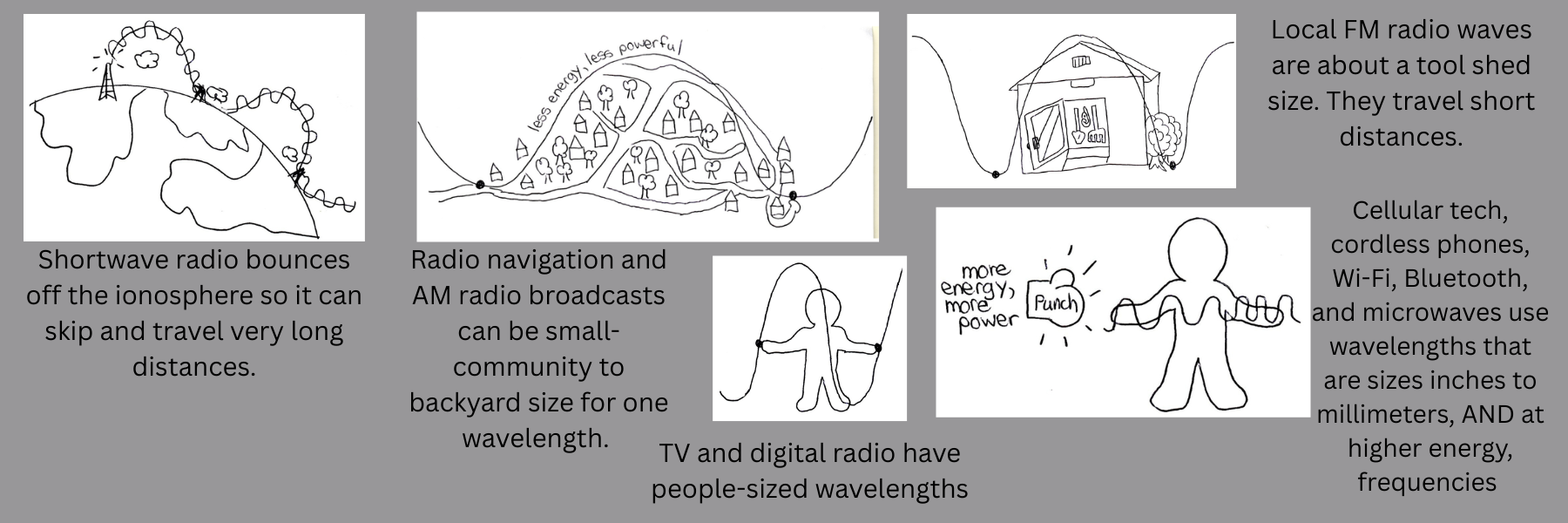
WAVELENGTH: This is the measure of how wide apart the peaks (or any other point “in-phase”) of the waves are. Depending on the category of emf spectrum wavelength, it can be various sizes.
- The left side of my diagram would have big wavelengths of kilometers or miles in size.
- Then the wavelengths would be a few meters or a kilometer or so in size for the section of radio such as for AM/FM radio signals.
- For cell phones, Wi-Fi routers, etc., the wavelengths are centimeters or inches for lengths, up to millimeter-sizing (mm). In other words, people, animals, and insects are the “right-size” to be “hit well” for these sizes. These are “creature-size” waves.
- Infrared, visible light, and UV rays have smaller wavelengths than a mm size.
Again, I made quick sketches (not the best drawings but I think they can still be useful to get the general idea):
AMPLITUDE: This is the measure of how high the waves are. Amplitude has to do with strength of the waves. (Taller ones are stronger than shorter ones.)
RADIATION, FIELDS, WAVES: These words can be used as synonyms (i.e. mean the same).
- When the electromagnetic (charged) particles move, they create fields which transport their energy. Another way of saying it is that fields are radiating wavelengths. But we tend to use the term “fields” when talking about electricity from powerlines and in building wiring (e.g. electric fields and magnetic fields) and “radiation” for the wavelengths that are being emitted wirelessly and for high energy categories such as ultraviolet and gamma rays.
- “Radiation” can also be simply defined as the transfer of physical energy which can be described as particles/waves through a space or material. It radiates in any direction (e.g. up, down, around). (This is described in a video cartoon link under the infrared section.)
- We should also understand that radiation is not always a harmful thing; radiation is simply the movement of physical energy that goes places. It’s the amount of exposure, the power/strength, and the various characteristics of the specific type of radiation that makes a difference as to if it is harmful, tolerable, or beneficial to life!
WAVES carry energy – so people sometimes want to know the strength/sizes (wavelengths, amplitudes) and frequencies (how often) of waves.
Manmade WAVES also carry information on those waves. Living organisms can use information carried by waves in a highly-complex manner. Waves with information are known to sometimes interrupt or interfere with electronic equipment (which is called EMI – electromagnetic interference). And they can do similar but more complicated effects on things that are alive. Communication devices (digital, electronics) are carrying lots of information, pulsating that information to “ride” on the emf waves. A little cell phone, for example, radiates a complex variety of lots of pulses and waves at various frequencies; studying its impact on living things is quite a complex matter!
CURRENT: This word describes the movement (flow) of charged particles (e.g. ions, electrons). Since this study is about emfs, I’ll further define electrical current as the flow of electrons (electrical charges) through/along space or an electrical conductor (such as a metal pipe or a copper wire). The rate at which electrons pass a point in a complete circuit can be measured in amperes (amps). For more information, see this link or this link to learn about electrical matters.)
- Direct Current (DC) – the current flows in only one direction. Examples: using DC batteries, DC generators of electricity, natural static electricity, and most of Earth’s protective magnetic field.
- You can also think about bar magnets hanging on a string and having their ends point to the north or south pole so we’d label the ends “N” or “S” as a result of the force’s attraction. With DC (direct current), there is a stationary (non-changing) ‘north and south pole’.
- The frequency is 0 Hz (because it doesn’t switch back and forth like AC).
- People who are truly “electrosensitive”, are sensitive to the frequencies involved with AC electricity; they can use battery-operated things instead (if such are available) because it is DC, not AC. For example, hair-cutting equipment that is battery-operated instead of using a two-prong plug can be a good idea!
- As mentioned, most of Earth’s magnetic field is DC. (We have a stationary north and south pole. Penguins live by the south pole.) Lightning itself is also DC but it provides quick and brief moving charges which are powerful enough to make a bit of an impact.
- Solar panels take electromagnetic energy from the sunlight and make DC current too. With an inverter, that DC current gets converted to AC current instead. (For an emf-sensitive person, the DC aspect can be just fine but they might want to avoid being close to the inverter which produces magnetic fields in its work; for example, to place the inverter perhaps 30 feet or more from a house. Two other things to avoid with solar would be any RF-emitting parts (which are on some systems) and connecting also with the utility’s system (which would share a neutral and thus, a potential stray voltage issue if the grid has that on it).)
- Alternating Current (AC) – the current of electrons flow in a sine wave pattern. Examples: household electricity, electrical powerlines. Here is how AC electricity is sometimes illustrated:
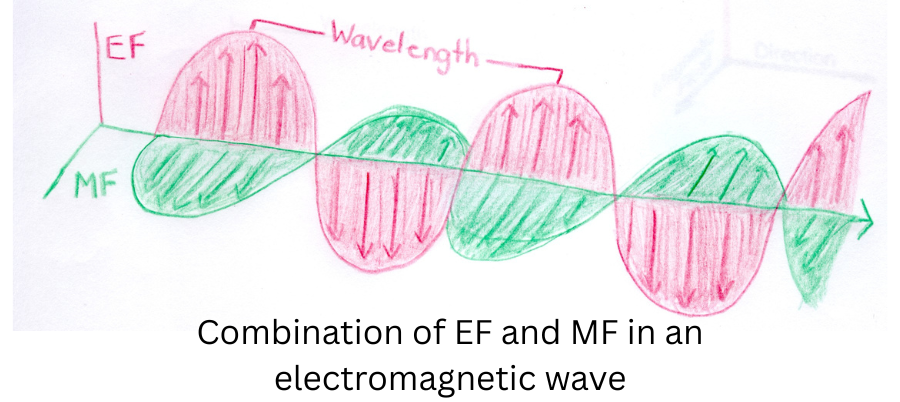
- The frequency at which the current alternates (switches) back and forth per second is measured in Hertz. Household electricity that we are familiar with every day is AC that alternates around 50 or 60 times per second (50 Hz in places such as Europe, 60 Hz in North America).
- With AC (alternating current), there is not a stationary (non-changing) north and south pole. Instead think of a changing magnetic field that frequently switches back and forth (alternates) from ‘the north pole to south pole to north pole to south pole’, etc.. This gives a changing field of electricity. Many of us have seen a squirrel running across branches or upside-down at a birdfeeder. Picture one of these critters alternating from the top side of a branch to the bottom side of it quickly as it speeds along – like at 50-60 times every second!!

Alternating Current (AC) produces voltages along wires as well as electrical and magnetic fields. AC is found within the “extremely-low-frequencies” (ELFs). Read more about the ELF section of the diagram in a later section. Here is a very short video which briefly explains what alternating current is.
VOLTAGE: This word describes the amount of pressure (think push) from the power source that moves the electrons to along the current of something conductive. It is measured in volts (V), millivolts (mV), etc.. Examples: The voltage follows a loop (circuit), pushing the electrons to do their work, such as making a lightbulb work. We also know that there is powerful/high voltage with a lightning strike.
CONDUCTIVE: Some materials conduct the flow of electrons easily. (“Non-conductive” materials resist that flow or don’t allow current or voltage to flow in it or on it.) Examples of conductive materials include metals (e.g. aluminum, copper), water, and salt (the last two of which are components in many living things).
More Terms – The sections in the diagram
Because different frequencies and wavelengths share some common properties/characteristics, scientists describe them in categories/sections in an EMF spectrum diagram.
We should also have an understanding of a few more terms, sometimes used to describe more than one category in the EMF spectrum diagram. (These are the terms along the bottom of my diagram.)
IONIZING: The EMF waves that are grouped as “ionizing” have higher frequencies and enough energy to directly (e.g. immediately) break a molecule.
NON-IONIZING: The EMF waves that are grouped as “non-ionizing” have lower frequencies and do not have enough energy to instantly break a molecule. Therefore, these are thought by some scientists to be “safe”. However, with certain characteristics and strengths, non-ionizing waves CAN cause serious damage.
MOLECULE: Two or more atoms which are chemically-bonded together. Question: When a molecule gets broken, what’s getting broken anyway?
- Even mutations in DNA strands aren’t “breaking” a molecule. A mutation changes the sequence of the chain of molecules by doing things like duplicating, rearranging the order, etc.. If something actually breaks the structure of a DNA molecule itself, that is known as “DNA Damage”. But both this and mutations are known as errors which result in damaging effects to the living cells. (Source link.)
- A single skin cell contains many millions of molecules. So if an EMF wave breaks that skin cell membrane or other parts of the cell, this would still be called “non-ionizing”. A sunburn is an example of a cell being damaged/broken/burned but from “non-ionizing radiation”.
- My point: Exposures to “non-ionizing radiation” aren’t always “safe”. In the example of the sunburn, it depends on how strong and long are the exposures as to whether or not there is damage to the cell. We don’t need to get side-tracked with the question, “Does this damage a molecule?” Or assume that if the molecule is OK, then it is OK to use the item emitting that energy anywhere. We should be instead thinking, “Does this damage a much bigger thing, such as a living cell?
- And, for the example of the kinds of radiation emitted by a cell phone, a router, and Bluetooth, the answer is: Yes, this radiation does damage living cells! (We mention a 2025 technical research document on our weblinks page as an example of the results of scientific studies into this question.)
THERMAL VS. NON-THERMAL (ATHERMAL):
- Are microwaves thermal? See this interesting answer at this link by a scientist. Basically, that author explains that since all radiation carries energy, it is thermal and can heat up things, even if “non-thermal” radiation might do this in a different way compared to what is classified as “thermal”.
- “Athermal effects”, also called on my diagram “Interference Effects”, can be observed for essentially all of the categories.
- The “Is it a thermal wave or not?” question (expanded to the “If emfs aren’t thermal, they can’t burn/fry/hurt you” argument) isn’t a very meaningful question. We should know that microwaves can hurt (and wireless routers can too). And how they do that doesn’t have to be thermal (although it can be). They can cause damage through athermal effects/interference effects.
So yes, BOTH “non-ionizing” and “non-thermal” kinds of emfs can negatively impact living things!
Let’s Go Through the EMF Diagram –
Let’s now go through this diagram, section by section, starting at the right and going to the left!
(A reminder: To follow along better, print a paper copy of this diagram (or refer to one like it): EMF Spectrum to Print.)
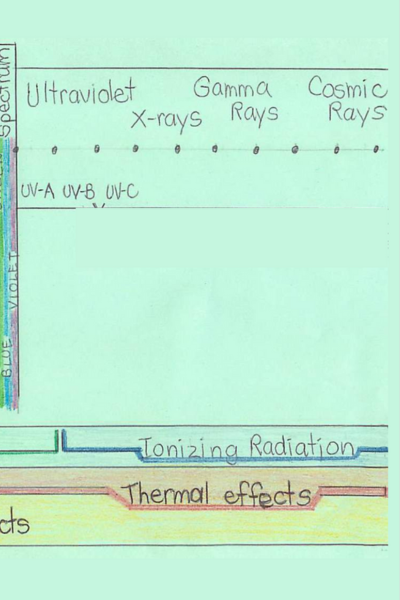
Cosmic Rays/Radiation
These are very very high energy waves, mainly in outer space. A cosmic ray is produced by stars, including our sun. Very very very little cosmic radiation reaches where we live.
But astronauts and even frequent fliers such as pilots have a higher risk of being harmed by these rays (because they are more frequently in higher elevations where there is less atmospheric protection).
To learn more about cosmic radiation, you can go to:
- Link 1 (from NASA’s website),
- Link 2 (from the EPA),
- Link 3 (a short article for kids),
- and Link 4 (for giving numerical values for Canada and other examples in the world for levels of cosmic and gamma radiation. However, their statements of us evolving to adapt to such radiation is nonsense and are based on unproven opinions intended to calm concerns.)
A general NASA article about space radiation and astronauts is linked here. Quotes from it include: “…each kind of radiation can cause damage to living and non-living objects, and precautions are required to prevent unnecessary risks.” “…researchers are still working to determine what makes one person more susceptible to the effects of space radiation than another person. This is an area of active investigation.”
Gamma Rays/Radiation
These are also very high energy waves, mainly in outer space. Again, thankfully, very little of the natural gamma rays from the sun reaches us where we live.
But humans have been able to produce and use gamma rays in industry, for destroying cancer cells in radiation treatments, from nuclear fission in nuclear power generation (for example at Bruce Power), etc.. When you hear the term “nuclear radiation”, this is the category that it fits into.
Gamma “rays” are also emitted as a result of radioactive decay products from some rocks/soils containing elements such as radon and radium. (Radioactive energy emitted from rocks/soils can be of three main types: alpha, beta, and gamma. Often, the radioactive rocks are emitting more of the alpha and beta kinds, less of the gamma, but I’ve included this paragraph because it relates to us thinking about radiation even though ‘radioactivity’ is a bit different than ‘radiation’.)
The gamma rays used in cancer treatments, food irradiation, etc., are from Cobalt-60 which is synthesized/manufactured/manmade, not occurring naturally (source link 1, source link 2).
X-rays
Also high energy waves, x-rays exist as both naturally-occurring (e.g. from the sun) and manufactured.
X-rays can be produced from radioactive rocks and from scientists purposely accelerating electrons in tubes to hit certain materials to produce them.
And that fun question you may have heard about bananas being radioactive?? You can learn about that here and here and here. (We don’t need to be concerned about bananas! You were designed to metabolize reasonable amounts of eating stuff like this!)
Ultraviolet Rays (UV)
Again, the sun is our main natural source of UV radiation. Some people are concerned about the potential of UV rays to cause skin cancers, although a level of UV rays are actually beneficial for our general health and produce Vitamin D, for example. (Source link)
Some animals have eyes which see colours within the section of UV (or infrared). (link 1, link 2)
UV rays can also be manufactured/manmade. For example, medical lasers can be in the ultraviolet, visible light, or infrared regions. (Source link)
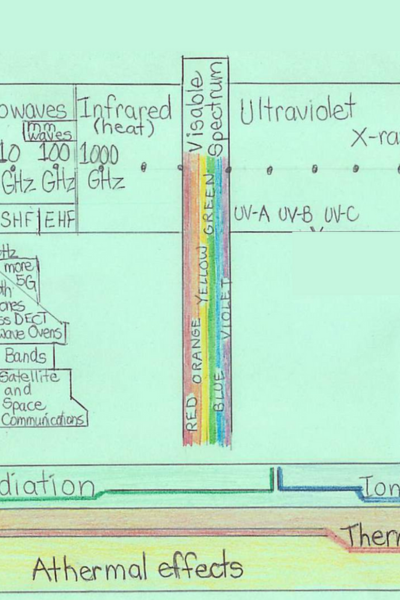
Visible Light
Sunlight again is the main natural source for visible light. Other natural sources include fireflies and other bioluminescent things found in the nature, campfires, reflection from the moon, and starlight.
A lack of exposures to natural sunlight is a growing concern among people, who see the downside of a society that stays indoors too much. Natural sunlight has many benefits for our health!
Humans have two ways of naturally knowing “night” from “day”. One way is with visual sunlight. (The other way is thought to be due to earth’s magnetic fields as it rotates, mentioned later.)
Artificial Lighting
Manmade sources for visible light include lightbulbs, screens with lighting (TV, monitors).
Of the artificial lights, incandescent bulbs tend to be the easiest to handle it seems for EMF sensitive people, although LEDs can be tolerated by at least some.
CFLs emit RFs and some people found them harsh and causing headaches. CFLs are being phased out currently due to pollution issues for disposing of these twirly lightbulbs.
Flickers such as in older fluorescent lights (slow pulses) as well as newer LEDs which pulse faster and with dimming effects (that’s how they electronically work even though we might not realize they’re dimming on and off fast) – these lights can be bothersome to some people. (I recall one of our electricians telling us he was changing these sorts of lights for a secretary who was affected by them as well as a store that was changing their lights.)
Having eyes exposed to too much “blue light” is a more-recent concern of many optometrists and others. (Source link)
And having a society that is now used to using artificial lighting to help them stay alert more, when it is naturally dark outdoors at night, is a concern of sleep specialists.
Real Visible Light, or Not?
To be correctly placed in the category of “visible light”, it needs to be visible as actual visible light. It cannot be just an invisible energy with assigned colours on a piece of equipment that someone wants to say is “like light”.
Yes, living things produce small amounts of electrical energy (i.e. action potentials along nerves) which can be measured in Hertz and biochemical energy (e.g. in cells as they work using chemical reactions). Some living things were designed with specialized chemicals which produce a visible light (bioluminescence) while other living things were not.
Yes, there are various kinds of physical energy that exist within the living human body. And, we can observe the effects of something being alive – their electrical signals move, the chemical reactions occur, cells divide, even certain emotions can release certain chemicals.
But we cannot see the “spark” of “life” or a light that means we’re seeing “life” or any immaterial parts of a person, not even with “special equipment”! Anyone who claims that it is possible, is misunderstanding what can be seen, and placing what they observe in the wrong category!
When scientists observe any kind of energy (e.g. chemical, gravitational, radiation, mechanical, etc.) they can associate, calculate, assign, or analyze the energy to be represented in a range of wavelengths; they could relate things further to be associated with a power or frequency too.
The Tale of Two Educated Experts
Once upon a time, there were two educated experts. (Whether they were scientists or journalists or just people who had some education and thought they could know anything, it doesn’t matter.) They liked to observe, compare, and associate things with things. And many times, their associations were pretty correct – but not always.
They liked to watch nature out the window of their lab. Each day, a big bear would come by at 4:00 p.m., close to one window, and stand up to punch a branch from a nut tree. His upright length was 2 meters. His natural colour was brown. And yes, he was certainly alive!
One of those “educated experts” wanted to have his own lab room on the other side of the building, since there was also a window there for observations. He saw the world from a different window view. He began noticing that something was being seen with a similar frequency – every day at 4:00 p.m.. It was 2 meters – same length too. It had energy as it hit a branch from another tree by his window. It even was brown! It must be alive too! He called it a “bear” and excitedly wrote down his new discovery because it shared some of the same characteristics, although not all characteristics.
What he failed to realize, is the truth. Each day, a schoolkid in the neighbourhood came by and rigged up one of those pop plus candy explosions under the tree by his window, just for fun. It wasn’t a bear after all. It was simply artificially-coloured brown pop undergoing a chemical reaction. (You can see this sort of reaction at this video link and perhaps you’d even like to do it yourself in your backyard!)
My point is –
Just because something has a wavelength and a frequency doesn’t mean it’s a “light” of some kind.
For example, people can attach the word “photon”, a word that is more-commonly used to describe light (although recall that it isn’t technically light itself even in its definition) to other things that they think they have discovered.
It is important to understand that kinds of physical energy (e.g. chemical, electrical, light, heat, etc.) are not the same as a “personal energy field”.
Nor is it a discovery of “science” to observe a light to call “life”. “Life” is not the same as “light”.
And just because something shows power or energy, such as lightning strikes or airplane engines, doesn’t mean it has life. Power, energy, and life do not mean the same thing.
Those claims have nothing to do with real science but instead, is a part of a pagan worldview used when they try to explain spiritual things through scientific-sounding terms or when they try to expand science definitions to include their belief systems.
Remember the ‘educated expert’ who spent time looking through two different windows.
If people think they can see actual “life” as a light, they attempt to look for how to manipulate it, fix it, improve it, so that humans and “science” can become ‘the hope of the world’. This is what human pride in own accomplishments can lead to (e.g. Genesis 11:4, Revelation 3:17-18).
Humans and science have limits to what can be known by us here and now. Some things about light only God knows (e.g. Job 38:19-21, 24-25, 35).
Are humans a natural source of light? No.
In the Bible, the word “light” is often used metaphorically to refer to invisible (not visible or physical) light meaning “not sinfulness”. We know that Jesus cannot lie because He is God. One of His titles is “the Truth”. Another title for Jesus is “the Light”, because He is without sin.
Jesus sometimes used truths in the natural world to convey a spiritual truth. In John 11:9-10, Jesus said that a person walking around does not have light in himself. And that the light a person can see is outside of himself! These verses refer to both a spiritual truth but also a natural truth!
Jesus knew what was/is inside people, both the material and the immaterial – He’s the Creator (Colossians 1:16)! So if Jesus said that people do not have natural light inside, we can trust this to be true.
We are not a source of light. We can reflect light from other sources such as sunlight. We can be amazed at ocean creatures that display visible light. They have a different design in their bodies than we have.
We can hold a lamp outside of ourselves to be a light (Job 21:7, Phil. 2:15). We can follow a light (John 8:12). We can display the light that is still separate from ourselves (Matthew 5:14-16). And even the “greatest” ordinary human being, John the Baptizer (Luke 7:28), was not a source of the light of life (John 1:8)!
Nor are we.
Infrared (IR)
Again, the sun is a natural source of infrared radiation. We feel infrared as heat – think of the sun warming your back or your face, toes, and hands feeling the warmth of a campfire!
For some things (but not all things) heat can also have visible light, such as with a newly-named hot ribbon in the atmosphere called Steve and of course, we know that fire is a source of both heat and light.
We even produce and emit heat, and so do other warm-blooded creatures. People give warm handshakes, warm hugs, sit close together in the cold, etc..
There are a couple of short “Eureka!” physics videos about how infrared waves transfer heat to things here and here.
Infrared can also be manufactured/manmade. For example,
- Remote controls for TVs, etc. have historically tended to use infrared rays (IR).
- (Note: Some TV remotes now use radio frequencies (RFs) instead. That means that the RF remote controls can continuously emit wireless signals to seek for connectivity like a cell phone does, not just emit a signal when a button is pressed. RF emissions are stopped if the batteries are removed.)
- Back-up cameras as safety features on vehicles can work with infrared technologies.
- Toasters, electric space heaters, hair dryers, and hand dryers use infrared.
- Infrared therapy used in physiotherapy can speed up wound healing.
Microwaves and Radiowaves (RF)
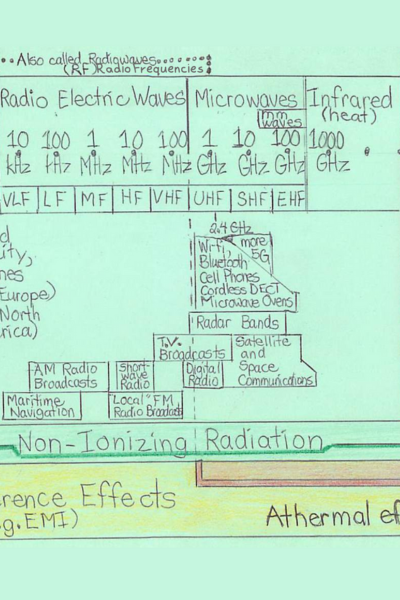
(The area of 3kHz to 1 GHz are sometimes called just “Radio waves” or “RF” or “Radio Frequencies”. This is why it’s drawn overlapping into “Microwaves” section.)
You can also see on my diagram, a little part under the word “Microwaves” that shows the sub-section of “mm waves”. The 30 GHz to 300 GHz portion of the microwave section is sometimes just called microwaves; but sometimes it is called “mm waves” (millimeter waves) because the wavelengths in this section are measured in sizes of millimeters. (Recall the grey sketches for wavelengths illustrated in the “Terms” section above.) The microwave or mm wave section contains some frequencies of the 5G-related wireless signals (and 6G).
As an example, a Wi-Fi router that emits around 2.4 GHz means 2,400,000,000 waves of radiation emitted per second. That radiation lessens with more distance away from the source of course. (You can input your own examples of technology at this page. Recall that Hertz (Hz) means waves per second.)
Almost all radiowaves or microwaves that humans are exposed to, are artificial, manmade ones!
Natural-Sourced Microwaves or Radio Frequencies?
For sure, natural microwaves in our natural living environment on earth, are very few or none. We’re again, protected from microwaves coming from the sun. Remember the diagram of the solar radiation reaching Earth? Here are those links again: Link 1, Link 2 (similar info but simpler to read)
There is a debate as to whether or not radio frequencies [of the popular range of RF-EMF frequencies used heavily in mobile communication devices] actually exist naturally. Here is a quote from a science research article:
“There is no physiological RF EMF in the living organisms, neither in the natural environment, despite the confusion and misinformation among the scientific community for the opposite…” (Source link, see page 3 of that article)
What about lightning? Some websites mention that natural lightning strikes (which are DC electricity, not AC) can produce/radiate emfs in the ELF range as well as into the VLF section of RF (i.e. “extremely low frequencies” up to 30 kHz). Lightning can be detected by VLF receivers.
We know of course, that lightning also produces frequencies of heat (infrared) and of visible light (because we can see it flash). So lightning has a very wide range of frequencies it emits. Two other technical articles (link 1, link 2) say that lightning may produce frequencies within the other radiowave sections.
But regardless, even if lightning does naturally produce RFs and microwaves, that fact doesn’t mean that it is also “good” for us to be close to it!
Artificial Radio Waves and Microwaves
MRIs (Magnetic Resonance Imaging) use magnets with non-ionizing radio waves. (Source link.) They are often considered safer than CT scans unless the patient has metal implants. CT scans use ionizing waves, similar to the risks associated with powerful x-rays. But CT scans still can be helpful if the image needs to be fast. (MRIs take longer to get the image.) PET scans use gamma rays (ionizing radiation) but can be useful for some diagnostics. Ionizing scans are very short (to limit exposures) whereas an MRI can be several minutes in length.
RF-EMF in people’s daily lives though, is most often found in Wi-Fi, Bluetooth, cell or smart phones, wireless computer devices, “smart watches”, smart meters, CFL lightbulbs, microwave ovens, wireless baby monitors, printers, cell towers, and 3G, 4G, 5G signals. Cordless phones (sometimes called DECT phones) are another very significant source of RFs.
Properties/Characteristics –
Of course, the variety of regions within the radiowave/microwave section(s) of the diagram can correspond or be associated with various physical characteristics that describe how these frequencies behave. Here are a few of those properties –
- Microwaves don’t propagate by a ground wave or ionosphere reflection (in other words, like shortwave, AM, or FM radio signals do). They are “line-of-sight” only. (This means they only work from antenna to antenna (or device to device) if they are within a short-enough distance and are not blocked from “seeing” the source of where a signal is sent from or is going. They call this receiving and transmitting at signal). This is one of the ideas behind the “internet of things” – to have enough items to pass the signal along, such as from house to house through modems/routers and small antennas along powerline poles or roofs of buildings so that all things along the path are “blanketed” with these microwave signals.
- Radiowaves which have lower frequencies – those on the left side of the section – these tend to have longer wavelengths and less energy (are less powerful). They can travel over great distances but they need longer antennae, which can be inconvenient.
- Radiowaves which have higher frequencies – those in-between the left/lower side and the microwaves – these tend to have short wavelengths and more energy, more powerful. Some of the frequencies within this section also have the ability to interact with Earth’s ionosphere and skip to greater distances if conditions are favourable. You can see some of the history of using the ionosphere for radio transmission at this link.
- EMF-sensitive people in general do not seem to be very sensitive to AM or FM radio. And T.V. signals may be fine too, at least the frequencies used before more of the digital-based ones. When these radio waves reach where most people are, they are relatively low in energy and of course, are longer wavelengths. (If one were to live very close to a transmitter or work at a station, then there could be higher exposures to those low-energy waves – but that isn’t the situation for most people.)
- A fun fact: As a teen, I actually considered applying to work as a musician in short-term missions at the shortwave radio station, HCJB, and picked up information for it one summer at camp. I knew a bit about shortwave since my family liked to listen to shortwave stations at home sometimes. I appreciate that their mission is not just interested in presenting the gospel through technologies but instead, to be also involved with in-person ministry in obeying the call to be witnesses for Christ – Matthew 28:19-20, Luke 24:46-49.
- Another fun fact: Today sometimes, a pre-loaded mp3 player is used in reaching people in remote places around the world with God’s Word. This kind of device can have a FM radio receiver in it or not. But it does not need to be built with cellular connectivity for online activity. In other words, even though cell phones are sometimes used for evangelistic purposes, a cell phone remains NOT a “need” for Christian ministries! An example of something I have been is a solar-powered audio unit like the one described at this link. It has no RFs-emitted from it. (The Keys for Kids Storyteller unit is very similar but has children’s stories on it plus the audio Bible – without the ability to connect onto the internet. It also is available in a number of languages.)
- Why not think about ways that technology could be used safer and better than the popular cellular or “smart” items that tend to trend in our culture, especially when trying to help people on a daily or weekly basis?
Concerns about RFs –
The wireless RF which tends to bother EMF sensitive people are the manmade, pulsating signals measuring in the frequencies which are in the right section of the RF. But now that 5G (and 6G) mm waves are being introduced, a wider amount of frequencies, stretching further right yet within the microwave section of the diagram, are becoming more common. This is why I’ve put both radio waves and microwaves somewhat together in one bigger section.
We usually shorten that portion of the section to just “RF” or “RF-EMF” to mean the section of manmade, pulsating signals in and around that general section of the EMF spectrum diagram where wavelengths are “creature-sized”. Sometimes we just call this section “wireless communication signals” or “wireless signals” and also not meaning to include the AM, FM radio signals (which transmit also of course, wirelessly).
To make things more complicated, in order to work for mobile phones, towers, Wi-Fi, Bluetooth, etc., wireless microwave RF signals aren’t just by themselves. They are a conglomeration or combination of a hundreds of varying frequencies “riding” and pulsating along on ELFs and the Radio Electric Waves (VHF, VLF, etc.) sections.
Historically, RF-EMFs have already been studied years ago, and known to cause health concerns. You can see a simple summary of the 2000+ documents dated from pre-1972 at this link (Glaser 1972). You can also see a list of potential symptoms summarized at this link (SLT, Canada).
Can RF’s be blocked in some way naturally?
Yes! RFs have a physical property (characteristic) of being able to be transmitted by “line-of-sight” only.
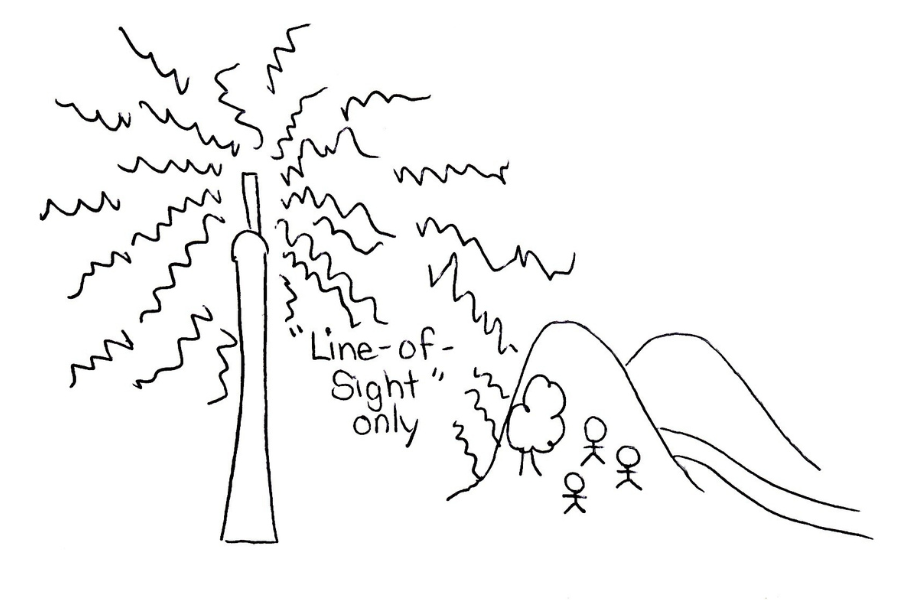
In our natural world, RFs coming, for example from cell towers or Wi-Fi in our neighbourhood, can be blocked or greatly reduced from reaching certain areas.
This is why a cell phone, for example, might not have a “good connection” and the solution to those wanting to use one is very simple: Go away from trees and steep hills to make your phone call (or wait if it’s not important or ask people nearby to help you). If you’re in an area of rocky mountains, remote valleys, or the beauty of forested trails, decide if it’s worth a “risk” to not depend on your cell phone in those areas. Generations for centuries have taken such a “risk” to enjoy nature – without any towers. Don’t demand for cell coverage in such natural areas! If you want to enjoy nature, then enjoy it – naturally so.
- Rock blocks or absorbs RFs. Cement, soil/dirt, hills, mountains – these all stand in the way of RFs going through. Such hilly landscapes can create “black holes” in the valleys – areas of no cell coverage (unless the tower is high and emits over the hilltops). Cement blocks can absorb the RF energy and convert it into heat energy (e.g. recall the law of thermodynamics). Cement buildings or walls of rock can be useful to park near to eat a lunch when out shopping in town or stand against if the source of the RFs is on the other side and you want to avoid the RFs. Underground basements can be devoid of RFs coming in from an outside source (unless through windows/doors).
- Metals block or reduce RFs. Depending on its thickness, metals such as aluminum, copper, silver, stainless steel, etc., can stop RFs. Think of metal doors and roofs. (“Tin foil” and foil blankets can reduce RF signals but are thinner. So are metallic screening or netting or metallic fabrics which are combinations of non-blocking threads with some metallic component with those.)
- Metals are also reflective; RFs can bounce around on metal sheets and through holes.
- Metals are also conductive, meaning that they carry electrical charges well, so shocks are a possibility if also in an electrical environment.
- Water scatters or blocks RFs. Tree leaves contain water and this is why it is explained that trees block or reduce RFs, for example, having tree coverage around a house can be a good thing, especially for people who’d like to reduce RFs from reaching their home. It is also a reason why cell phone signals do not work as well in fog or rainstorms. For those who are sensitive to signals from cell towers, it can be a bit better to go out shopping when there is more water in the lower atmosphere. (link 1, link 2)
I think the main takeaway point from this section is that God didn’t make the natural world where we live to naturally get lots of exposures to the radiowave or microwave section of the electromagnetic spectrum! It isn’t natural to be able to handle well the amounts/levels of exposures.
So when a person (or other living thing) shows negative health affects from RF exposures, he or she is simply responding correctly to “too much harm” in their environment. The problem is the environment, not that a person’s body is wrongly responding! The first bunch of people to notice the harm are simply like canaries in a coal mine. (I’ve written about views about causes of emf sensitivity at this linked post.)
To read about how RF-EMFs along with the ELFs effect cell biology, I have linked to a very interesting science paper (briefly mentioned earlier) from researchers in Europe, published in 2025, near the bottom of our Weblinks page. It explains about the RFs that get pulsed to ride in the ELF fields. In other words, it explains about a combination of emfs and how they damage cells.
Extremely Low Frequencies (ELFs)
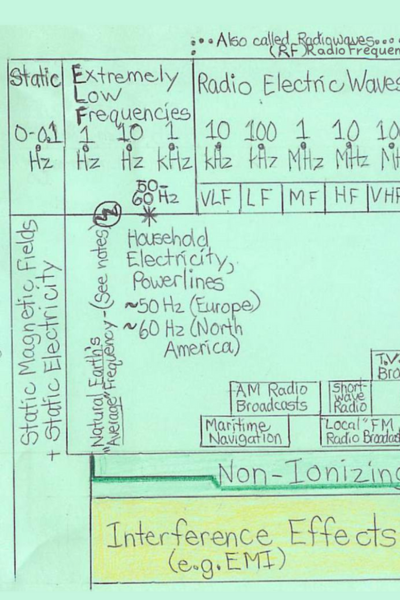
Note: Wikipedia states that ELFs are defined as electromagnetic radiation (radio waves): “…with frequencies from 3 to 30 Hz, and corresponding wavelengths of 100,000 to 10,000 kilometers, respectively. In atmospheric science, an alternative definition is usually given, from 3 Hz to 3 kHz.” And in health research, “frequencies between 0 and 100 hertz are considered extremely low-frequency fields.” (Source link). My hand-drawn diagram is attempting to illustrate the atmospheric science definition, used by people who study lightning.
The main point is that ELFs are very very low frequencies in comparison to the others – “extremely low”, thus their name – ELFs.)
Natural Sources for ELFs
Natural sources for ELFs include electrical nervous system signals in living creatures, including brainwaves (which can be measured by an EEG).
Electrical signals in living things –
Within our own human body nervous system, there exists various “action potentials” to make the parts of our bodies function – electrical signals which are at various frequencies depending on the level of activity of what is happening in various functions. These electrical signals/action potentials exist within muscles and nerves.
Do humans produce electrical frequencies which exit the body, going through space and into another creature? No.
But electric eels can. They have specialized cells in a Sach’s organ called electrocytes. Each of those cells might only produce 0.15 volt, but when acting together, they can “transmit a signal of about 10 volts at around 25 hertz”. Additionally, the electric eel has three other organs called the Main organ, Hunter’s organ, and Sachs’ organ which can work together to produce “a shock at up to 500 volts and 1 ampere of current (500 watts)”. (Source link 1, link 2)
We can zap each other with static electricity or share “skin voltages” if touching each other (conduction of electrical fields existing on skin, those fields originating outside of the people and from manmade electrical sources).
But, humans don’t possess electrocytes to produce electricity like the eels can. We’re designed differently than eels.
For similar questions relating to how we communicate, including electrically, within our bodies, please see my blog post here.
For similar questions relating to how living creatures communicate between each other (e.g. in the environment), please see my blog post here.
For learning about 12 animals which have been designed with special electrical characteristics involving detection of electrical fields or generating electricity, you can go to this article by Discover Wildlife (BBC Wildlife Magazine). These include:
- echidnas
- electric catfish
- Oriental hornets
- sharks
- electric rays
- duck-billed platypus
- stargazer fish and
- knifefish (e.g. eels).
- And animals mentioned in that article which have features using static electricity (which is different than ELF currents or fields) include the ‘electric’ butterflies and honeybees.
Magnetic Fields (MF) – Artificial
Note: The MF in the ELF section has to do with magnetic fields from moving of alternating currents of electricity (not the static kind of natural fields of magnets holding up drawings on a refrigerator or played with in science class).
Magnetic fields are produced in two ways:
- By magnetic materials themselves – a permanent magnet always as a magnetic field. The earth also has a north and south magnetic pole and the magnetic field around the earth is almost all DC (not AC). These have static magnetic fields and are found in nature.
- By the movement of electric charges (e.g. current flowing, an electromagnet coil). (If you’re interested in learning about how to make a simple electromagnet – its magnetic fields can be turned “off” or “on” – here is another link to a short video.) These are manmade.
So #2 (above) are manmade magnetic fields in the ELFs section. They exist in and near things powered by electricity. The electricity makes them.
Examples of things which can show MFs – a lamp plugged in and turned on, cooking on an electrical stove, wired digital alarm clocks (that are “on” and display the time), variable speed motors. Things with two-prong plugs typically have more MF in comparison to three-prong items.
The potential concerns of magnetic fields from electricity:
- High magnetic fields in a house, when measured several inches away from an electrical source, can indicate that there are wiring errors which need to be fixed. Normally, magnetic fields drop down dramatically when a gaussmeter moves further than a few inches away.
- Some studies have associated higher levels of magnetic fields to childhood cancer.
- “Dirty electricity” (DE) filters are known to slightly increase magnetic fields (or “dirty” the magnetic field while “cleaning up” the electrical field). Depending on what else may be going on in a household’s electrical system, that slight increase of MF can be sufficient for some individuals to notice ‘shocking sensations’ (pain/muscle contraction/stiffness).
- If an electrosensitive individual has had recent or current other exposures to high-enough levels of electricity or wireless RF/microwaves, being close to higher levels of magnetic fields (e.g. cooking at a stove) can increase symptoms when around MF (e.g. dizziness). (For the “bucket analogy” of a total body burden, please see this post.)
- If a person is wearing metallic (highly-conductive) clothing, such as because of shielding from RFs, and that person is also close-enough to high magnetic fields (e.g. being near/under high-voltage lines or large sound amplifiers or a stove or electric heater, conduction can cause muscle twitching, etc.. The simple solution is to not wear conductive clothing when near high levels of MF.
How ELF Magnetic and Electrical Fields are Related –
I liked how this definition was worded:
“The region of space surrounding a magnet which exerts a force on other magnets is called a “magnetic field”. Magnetic fields are caused by electric current—motion of charged particles…James Clerk Maxwell discovered the four equations which govern the behavior of electric and magnetic fields. Magnetic fields are caused by electric current or a change in an electric field.
[And likewise,] electric fields are caused by charged particles, or a change in a magnetic field.” (Source of quote link)
Re: Tools:
We rely on meters to measure these fields where they exist, because they are invisible.
- Magnetic fields can be measured with a gaussmeter.
- And electric fields can be measured with a multi-meter (in mV or V).
- I demonstrate these tools on our “short videos” page and describe these further on our post about “Measuring Tools and Building Biology” linked here.
Electrical Fields (EF):
(On our website, you can read more about electrical fields at our post here about Stray Voltages. And you can see short videos that we made about electrical fields at this link.)
Electric fields are produced from voltage. Electric fields exist near powerlines and in homes with AC household electricity. Lots of EFs can be in an environment as a result of ungrounded metal roofs, poorly-shielded wiring, or stray voltages.
EF is an AC field, a field that keeps changing quickly. Remember the alternating squirrels mentioned back in the section of our terms? Recall that AC electricity changes its field about 50-60 times each second (frequencies measured in Hertz).
Why does 50 or 60 Hz electricity affect at least some people’s sleep and/or muscles?
Short answer: No one really knows for sure yet. Some people have an idea/hypothesis but little has been researched yet.
We already know that there are people who experience poor sleep quality issues, who also find much relief in environments without manmade emf sources. So there IS an association. Electrosensitive people become more-sensitive to electricity as a result of over-exposures to such. (See our post about stray voltages here.)
In electrosensitive individuals sleeping in a low-electrical situation, the following problems can significantly lessen. And if there is no electricity (and no RF-EMFs), such as in power outages, these can completely disappear: sleep starts (more-than-average amounts of sudden jerks and twitching as drifting off to sleep), restless legs (a semi-voluntary movement and sensation of ants crawling or similar), periodic limb movement disorder (twitches during sleep), isolated/idiopathic sleep ‘paralysis‘ (when person is fully awake but body is still sleeping completely or partially for a bit). (More about “sleep disorders”, might be linked here later.)
But to test out specifics of “why” or how an electrical environment causes symptoms in comparison to a low-electrical or non-electrical environment, would be very difficult to study:
- To even design an experiment to measure natural electrical signals via an EEG (which shows brainwaves) and EMF (which shows muscle movement or tension vs. relaxation) WITHOUT having manmade electricity or wireless signals powering equipment or also skewing testing results, would be very difficult, if not impossible.
- Gamma-sized waves in the brain (which are different waves than the spectrum diagram’s gamma rays near the cosmic rays) are 30-100 Hz, in the same range as household electricity. But it is already known to be difficult to measure gamma in an EEG and distinguish them because of the overlap of head muscle signals which are also usually present. (An EEG has electrodes on the scalp, attached to the skin unless it receives signals from holes in the skull in some patients.)
Below are three hypotheses for why/how electrical fields impact sleep. (General references for the known facts are listed at the bottom of the page.)
- MAYBE the 50/60 Hz household electricity, at heavy-enough levels, interferes with the slower brainwaves during sleep. In other words, artificial gamma waves interrupting or building up to a point of adding unnatural bursts of wakefulness in a stage of deeper sleep.
- However, it is also a fact that gamma waves, while thought to be more common during wakefulness and intense thinking like problem-solving and writing tests, are also normally present during all stages of sleep to some extent.
- Q: Is that “normal” also in our natural sleep or just “commonly-observed because a person is tested under the influence of electricity in sleep studies?
- Q: Is there a point of levels of tolerance, for how much can be compensated for through our body’s homeostasis controls?
- However, it is also a fact that gamma waves, while thought to be more common during wakefulness and intense thinking like problem-solving and writing tests, are also normally present during all stages of sleep to some extent.
- MAYBE K-complex spindles or K-alpha wave complexes seen during sleep and noticed by sleep researchers are the reason. K-complex spindles may be normal but what their function is remains mainly a mystery yet. Some sleep disorder specialists see more K-alpha waves in stages 3-4 of sleep with chronically-fatigued patients and believe that those are unnatural/unwanted interruptions causing poor restorative sleep quality. “From where” these k-alpha waves come from for what is causing them, remains unknown or unconfirmed.
- Alpha waves are thought to represent a wakefulness/drowsy state according to sleep specialists. So they ask, what are the larger-than-normal amount of K-alpha waves doing to intrude into the restorative sleep stages 3-4 with their little bursts of “wakefulness” and which are so small that a person generally doesn’t noticed they have wakened at all? These patients feel non-refreshed and very tired in the morning but can think that they were sleeping ‘all night’. Perhaps there are more than one type of alpha wave, with different functions. (If interested, you can go to this Wikipedia description where it mentions “sleep”.)
- But, alpha waves also do not have the same frequency range as household electricity. Alpha waves are 8-12 Hz instead.
- Q: Does the speed and thus, frequencies, of 50/60 Hz waves decrease if such travels through skin, muscle, and skull? Does such become only “alpha frequencies” by the time it hits inside the brain’s regions responsible for such a pattern of complexes?
- Q: If 50/60 Hz decreases to alpha wave levels inside the brain to cause K-alpha wave complexes, why are these occasional bursts, instead of something constantly intruding? Is there something in the brain that tries to compensate or regulate unnatural electrical stimuli but periodically gets ‘overwhelmed’ to allow a quick complex to occur?
- MAYBE it’s caused by electrical fields stimulating the skin? We know skin is conductive and so are muscles and nerves which run along muscles and can quickly transport signals to the brain.
- Q: Is the site of origin instead electricity stimulating muscles to act “awake” during relaxation or sleep – the skin voltage affecting the muscles/nerves, sending signals to the brain to respond to with K-alpha wave complexes?
- With a multimeter, we can measure a fluctuating voltage both at the main electrical panel of a house as well as on the skin of anyone under the influence of electricity.
- We know that electrical stimulation on skin easily affects muscles. (Think of a small shock, even from static electricity from a sweater to a metal door.)
- People doing EMF/nerve conduction testing can show that outside “small” levels of electrical stimulation can send electrical signals from skin to muscle to spinal cord/brain. (Fascia might also be involved but I consider it as part of the muscle or skin system.) The muscle reaction is to contract, twitch or have tension. And a “maximum” tolerance level can be reached, at least in the muscles, at which it’s “muscle fatigue” where it can’t tense further at that stimulation level until it gets a few moments to “reset”. (See this short video link if interested in what EMG/NC testing looks like.)
- We know that muscle is a body tissue that can contract, but also an additional ability to relax, and therefore, reset, before contracting again and again.
A good link for understanding the science of sleep in general is this one: “God’s Gift of Sleep”.
Can these manmade MF’s or EF’s be blocked in some way naturally, if the levels are too high?
Sometimes. But since these are fields from AC (alternating current), it is not easy to totally eliminate them in buildings, unless they are fully switched off/disconnected from electricity. There are however, ways to reduce them.
- Being outdoors on the real ground, the EF disappears (away from power sources). But some MF running in wiring beneath the soil surface could still be measured through soil. Ground current in places which have it from the electrical system(s), may also be present. Choosing to live away from transfer stations, high-voltage wires, etc. and living more in a natural environment (e.g. spending more time outdoors) is beneficial.
- Some metals can block EF and MF well. This is the idea behind shielded wiring used in industrial buildings (and some residences) as well as some specialty paints. However, like mentioned before, metals are also reflective and conductive, meaning that they carry electrical charges well. It can be difficult to do all that needs to be painted or covered to do that and not make a problem worse. (The fields would still emit at/from the outlets, of course. So if there are voltages on the neutral/ground wiring, fields would still be present from those.)
- Other common solutions are:
- to find the source of electrical problems and fix it.
- to use the idea of distance to be further away from the fields, since both EF and MF will lessen to zero/nothing as the distance from them increases.
- to find alternative ways to do “work”. Instead of electrical appliances, for example, using battery-operated or old-fashioned manual items to get tasks accomplished.
- Grounding – Electrical systems must be grounded properly to be safe. Connecting to the real earth (soil) grounds excess electrons. You see a short video that explains this here.
One more thing to mention in the ELFs Section: the “Schumann Resonance”
You may have heard of this term. Some “health and wellness” people like to use it to promote products which “have it” on them. They claim that this is a frequency that helps people get better. So what is it?
In nature, it doesn’t exist as a single, constant number. The average number of around 7.83 Hz representing various levels of natural electromagnetic activities…the lightning strikes, the Northern and Southern Lights (auroras), etc.
“His lightnings light up the world; the earth sees and trembles.” Psalm 97:4 (ESV) Such a Bible verse indicates that the earth does tremble from lightning strikes and perhaps we have even felt the sound of thunder which would be similar.
Let’s say you live in a climate that has rainy weather most months of around 12.8 days per month. You’d understand that that number doesn’t mean that exactly 12.8 days all in a row in every month has rain and the rest do not. You’d understand it as an average instead.
And that is what this number of ~ 7.8 Hz is, plain and simple – just an average of lots of variances. Is it really “significant” for what some people think it is? I don’t think so.
It hasn’t been studied much so the salespeople are ahead of science research it seems, like they are with some other gimmicks. Plus, with a machine producing a constant signal instead of the variability of what may be in nature, that’s quite different, not even similar. EMF sensitive people are like canaries in a coal mine; I’ve heard that such devices can make at least some feel worse.
And really, if this is a “natural” thing that is beneficial to us humans at “natural”, average levels, it doesn’t need to be manmade! Let’s just spend some reasonable time outdoors in nature for free!
Static Magnetic Fields and Static Electricity
Static Electricity – yes, the kind that we experience as little (or big) shocks when touching charged sweaters, doorknobs, etc.
Magnets – yes, the kind stuck to refrigerators or played with in science class! These have Static Magnetic Fields.
We can feel the invisible forces of repulsion and attraction as their fields push or pull on their ‘north’ or ‘south’ poles. People can watch tiny iron filings arrange themselves to show the strength and direction of these fields too. (If you’re interested in seeing that on a short video, here is a link.)
Learning about these natural magnets can help us understand how physical magnetic fields of any kind behave!
Static electric and static magnetic fields are considered “constants”. Their frequency (of how often) is basically nothing (0 or 0.1 Hz maybe) and they have very low energy in comparison to the rest of the spectrum diagram.
“Static” is associated with DC (direct current) which means that the energy flows in only one direction instead of alternating back and forth quickly like the fields of MF and EF in the ELFs.
The Magnetic Field Surrounding Our Planet Earth
Scientists believe that the magnetic field of our planet is due to electrical currents existing deep within Earth’s layers when molten (hot, melted) metals move around as the planet rotates, etc.. (Source link)
The magnetosphere is the name for the invisible magnetic field “bubble” that surrounds our planet. (It relates to the outer ionosphere but has its own characteristics too.)
Below is an artistic illustration of the magnetosphere that helps protect us from the sun’s radiation.
On the left is the sun and the small ball on the right represents our planet, Earth. The blueish/purplish lines represent the magnetic field that reflects much of the sun’s rays back into space.
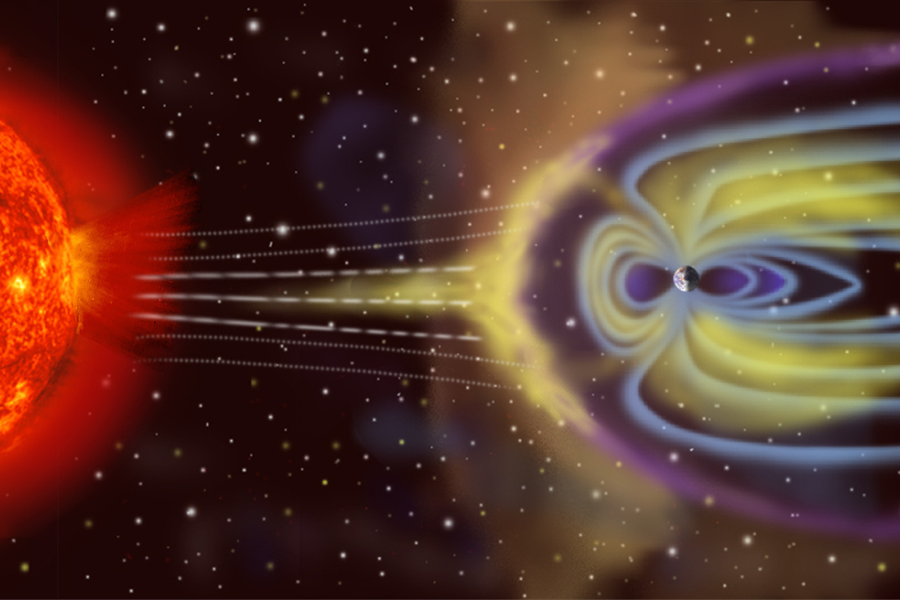
You can notice that the magnetic field lines come closer together near the north and south poles. Some of the charged particles from the sun’s radiation travelling along those magnetic field lines are then closer to where we can see them if we’re closer to the polar regions. These charged particles interacting with gases high in our atmosphere are what we see if we see the colourful displays of the auroras such as the Northern Lights. (You can read more about the Northern Lights in a short article at this link: Northern Lights.)
One additional thing you could note from the above diagram, is that the magnetic field around the earth is not symmetrical for the day versus night halves – it is “shorter” on the day side (facing the sun) and “longer/further” on the night side.
Apparently, if a person is shielded from magnetic fields, the sleep cycle can get mixed up somewhat.
The circadian rhythm of living organisms, including humankind’s sleep/wake cycle, seems to be naturally regulated by not just the amounts of sunlight telling us it’s time to wake up or go to sleep; it also seems to involve the varying amounts of magnetic fields to tell us when sleeping or wakefulness is good for us.
This fact that changing amounts of magnetic fields can have something to do with when our bodies should sleep versus be awake, leads some people to hypothesize about the influence of household electricity with its artificial electromagnetic fields operating in our sleep environment.
There are also guesses as to what senses magnetic fields to regulate the sleep/wake cycle but I’m not certain yet that scientists have figured it out yet for how that works. It is perhaps related to melatonin secretion or other things in certain parts of the brain.
Sleep is a complex function.
Can God be explained as EMF?
No. The true God is not a particle and He is not a force of energy.
For a more-detailed answer, please also read my post, “Who is God?” (Choosing to Live with a Biblical Foundation: Part 2). I have purposely addressed the issue of quantum beliefs in that post, more than the below comments.
Sadly, such ideas are sometimes added to physical science studies and “wellness” offers. It is important to distinguish truth from error if you are being informed about “quantum spirituality” (which is false but uses similar science-sounding terminology) alongside “quantum mechanics” in school classes, by health care practitioners, or seeing ideas from both meshed together as if they are both true on EMF information websites and seminars.
God has always existed – this is the nature of God – being eternal (e.g. Psalm 90:2, Isaiah 40:28). God existed long before our world, including emfs, ever existed. Energy and matter came into being. These were created. (Here’s also a link to an article about the fact that energy and matter are not eternal.)
The created world/universe serves God and are under God’s command and sustaining power. (e.g. see Psalm 119:90-91, 19:1-6; Hebrews 1:3, 10-12)
Our natural world declares and shows God’s power, mercy, perfect creativity, knowledge, etc. but it is different than God.
The true and living God also has personality and care. And He cannot be measured nor can He be contained/limited to any specific dimension of work. He cannot be manipulated as an impersonal force either.
God cannot be reduced into being described scientifically in terms of EMFs (or anything else in the universe). Keep these three points in mind:
- Holy – God is unique. We cannot equal Him to anything we observe in nature.
- Eternal – God existed before the sun’s radiation, etc.. Our world had a beginning when it was created by God. But God Himself is eternal. And He is self-existent, not created.
- Personal and Purposeful – He understands us, demonstrates kindness, communicates, works in power for a reason, desires relationship with us as individuals, etc..
EMFs have none of these characteristics. Let’s not follow the path of confusing who God is with emfs!
People who seek scientific explanations for who “God” is, are in fact, turning their backs and rejecting the true God Who has said that it is through faith that someone can know Him.
These people seek instead to give more worth (aka worship) to things in creation rather than the Creator and are in the process of getting ‘shipwrecked’ or ‘searing their conscience’ – to render it insensitive to feeling guilt when deceiving others with lies and turning from trusting God (1 Timothy 4:1-2; 1:5-6, 19; 2 Timothy 3:2-7). Simply put, these people will direct people into wrong ways of thinking so we should avoid learning spiritual-related things from them because they cannot be trusted to tell spiritual truth.
“…without faith it is impossible to please Him, for anyone who comes to God must believe that He is, and that He is a rewarder of those who diligently seek Him.”
Hebrews 11:6 (NIV’84, cross-reference to Isaiah 57:15)
“For since the creation of the world His invisible attributes are clearly seen, being understood by the things that are made, even His eternal power and Godhead, so that they are without excuse, because, although they knew God, they did not glorify Him as God, nor were thankful, but became futile in their thoughts, and their foolish hearts were darkened. Professing to be wise, they became fools…”
Romans 1:20-22 (NKJV)
Our Created World and Its Creator
Physics is a very objective, mathematical science. Trying to understand at least some of the topic of emfs can apply to your daily life these days and help you.
Students and teachers, we should aim to study well and do our best with learning real science. But we also should remember that we could try to know all the details in the world about these topics and still lose out on what is the most important – knowing the Designer and Creator of all things found in real science!
God of Wonders is a video we used to give out at homeschool conferences and can be watched now online in 4K. It’s a visual documentary that continues describing more about Who God is while showing many neat things that we can see in our created world.
Additional References:
Many years ago, my sister attended a workshop that was for both health care professionals and the general public in her region. The speaker(s) was one of the authors of sleep disorder booklets available for purchase at that time, especially written for those working in the medical field. She brought four of those little booklets back for me which are references to some of the information about sleep disorders. I also spoke with at least one of the specialists who worked on the team with Dr. C. Shapiro, during my university years about some aspects of this topic. The booklets are old but I think they still have some valuable general information at least. These are the titles I have read:
- Sleep Solutions: Sleep Function & Insomnia Assessment (Volume 1) by Jonathan A.E. Fleming, MB, FRCP(C) and Colin M. Shapiro, BSc(HON),MBBCh, PhD, MRC Psych., FRCP (C), under the auspices of Sleep/Wake Disorders Canada and Canadian Sleep Society, published by Kommunicom Publications, St. Laurent, Quebec, 1992.
- Sleep Solutions: Excessive Daytime Sleepiness (Volume 4) by Patrick J. Hanly, MB, BCh, BAO, MD, MRCPI, FRCP(C) and Colin M. Shapiro, BSc(HON), MBBCh, PhD, MRC Psych., FRCP(C), under the auspices of Sleep/Wake Disorders Canada and Canadian Sleep Society, published by Kommunicom Publications, St. Laurent, Quebec, 1992.
- Sleep Solutions: Pain & Distress At Night (Volume 5) by Meir Kryger, MD, FRCP(C) and Colin M. Shapiro, BSc(HON), MBBCh, PhD, MRC Psych., FRCP(C), under the auspices of Sleep/Wake Disorders Canada and Canadian Sleep Society, published by Kommunicom Publications, St. Laurent, Quebec, 1992.
- Sleep Solutions: Parasomnias (Volume 8) by Roger J. Broughton, MD, PhD, FRCP(C) and Colin M. Shapiro, BSc(HON), MBBCh, PhD, MRC Psych., FRCP(C), under the auspices of Sleep/Wake Disorders Canada and Canadian Sleep Society, published by Kommunicom Publications, St. Laurent, Quebec, 1993.
At the time when those booklets were published, I was not told anything about the connection of emfs with sleep. Perhaps that connection was unknown to those authors at that time. But more research into the connections has been done since by biologists, biophysicists, and others. And Building Biology standards began to be published also in 1992 (source link).
Various professionals who have been trained in the topics of “Building Biology” will understand that there is a strong connection of sleep being affected by manmade RF-EMFs and ELFs. Building Biology Standards (guidelines) emphasize bedroom/sleep areas and advise ways of reducing artificial emfs due to the research. You can read the Building Biology guidelines at this link.